Who Says it Never Rains in Southern California?

Downtown+Rain+[genericsla]

There are reasons why I never wanted to drive in California.

The first was because Los Angeles is sprawling and covered with roads swirling in random directions. New York is so much easier – north is up and south is down, east is Long Island and west is New Jersey, and eventually, the rest of the country. Then there are the 12-lane freeways, which terrify me, and the neighborhood streets (called ‘surface streets’ by native Angelenos, to my eternal bewilderment), which frightened me only slightly less. And finally, there was Jamie’s car, an extremely expensive, little, foreign, champagne-colored convertible that went from zero to sixty in a second and a half. Sitting in the bucket seats was like looking at the control panel of the Starship Enterprise from a hole in the ground; it was filled with anonymous buttons and knobs and lights, but nothing I could identify as useful, like an ignition or window control. As I possessed no advanced degree in automotive engineering from MIT, it was much easier to just ask Jamie to drive me places.

It worked out fine. I walked into salons or stores and he drove to the studio for a few hours while he waited for me. Then the unthinkable happened – he grew tired of taking me to my weekend appointments to get my hair cut or my nails done.

“Just take the car,” he’d sigh, tossing me the key while sprawled in a chair staring at the television.

“You don’t mind if I drive your car?”

“Why would I mind? You have a cleaner driving record than I do.”

“But my parallel parking isn’t so good.” That gave him pause. He was thinking about his fenders.

“Park in a garage. There is one directly across the street from Umberto’s.”

That is how I eventually learned to drive in LA. It was all right as long as I didn’t have to drive far or fast. Mostly I drove to Beverly Hills, since that was where my hair appointments were, and sometimes I drove to Culver City to pick up Jamie after work. In four years, I never touched a single button in the car except the seat adjuster. I listened to whatever music Jamie’s IPod played; I never opened the trunk; I never put the top up or down.

One August morning, Jamie asked me to drive him to work – he had appointments in the studio all day and didn’t need his car – and since he and I had tickets to a preview that night, I could get ready at my leisure, then fetch him, allowing us to head to Hollywood without his having to schlep back and forth from Culver to Santa Monica.   It was a beautiful, cool, sunny, morning and so early that there was almost no traffic on Lincoln or Washington. After clearing the main gate, Jamie parked perpendicular to the lawn behind the Mansion and kissed me goodbye. As he stepped out of the car and gestured for me to scootch into the driver’s seat, I suddenly panicked.

“Where is the key?” I asked frantically.

“There,” he answered, pointing into the little console well.

“I don’t have to do anything to the car, do I?”

Jamie blinked. “Like what?”

My mind raced. “Put gas in it.”

“Of course not. I know you have no idea how to do that. It amazes me, but I accept it. Although how you can be smart enough to earn a PhD in nineteenth century British literature and not know how to pump gas eludes me.”

“They are different skill sets,” I sniffed.

“Yeah. Okay. Look, just park in the driveway as close to the garage door as you can get but don’t pull in. Remember, don’t pull in. The garage is so small and the hood of the car is so long that I don’t think you will be able to see over it and you may hit the front wall.”

“Shit, I don’t want to do this. Even you don’t want me to do this.”

“You are fine when you’re driving; just be careful parking.”

He leaned in and kissed me goodbye again.

To this day I wonder how many Hail Marys he said as he watched me U-turn the car to exit on the other side of the guard’s booth.

I made it home without incident, and slid as far into the uphill driveway as I dared. Slamming the door and turning to look over my shoulder as I climbed the stairs to the walkstreet, I realized that the car wasn’t very near the door; sidewalking moms pushing baby strollers would have to veer around the back of the car, nearly into the street to get past. I wondered whether I should try to get closer. Nervous and deciding against it, I tapped in the gate code and entered the walkstreet.

After drinking more coffee, I packed my phone, a book, and a bottle of water, then spent most of the day reading on the beach, going home only when dirty-looking, grey, Nimbostratus clouds began to tumble over one another toward shore and the wind started whipping sand. Hoping the rain would hold off, I walked up the hill toward our house. Stopping to let a car pass on Third Street, I looked over and saw the car parked in the driveway; the top was down. Damn! I had no idea how to put it up. Well, maybe the rain would hold off until I reached the studio. Fingers crossed.

I entered the house, put out fresh food for Spencer, and decided to shower now. I would go to the studio early to meet Jamie; that way, I could get the car into the underground parking garage before the rain. He could finish work and I would read my book until he was ready. When we left for the premiere, he would put up the car’s top. I wouldn’t have to figure out which button to push.  Easy peasy lemon squeezy. “What a genius I am,” I thought, as I turned the knob for hot water in the upstairs shower.

An hour later I was ready to leave. As I turned to lock the heavy, oak, door, the wind caught the screen door and yanked it backward, breaking its hinges. My hair flew into my eyes as I tried to catch and secure it. “Wow,” I thought as I all but blew down the walkstreet, “this is really going to be some storm.” It wasn’t raining, yet, though, and I wondered how much longer it would hold off.   I hoped it would be for at least thirty minutes because that was how long it took to get to the studio at this time of day.

I backed out of the driveway and turned right at Mary Hotchkiss Park and right again onto Fourth Street to drive straight to Ocean Park Boulevard, where I would turn onto Lincoln. I knew only one way to get to the studio and it involved crowded main roads.

I made good progress for about four blocks, then all traffic stopped abruptly.   Shit. I needed to get to the studio. The wind was lashing my hair against my face; I glanced up into the darkening sky and wondered what were my chances for making it to Culver before the deluge.

I brushed my hand against my right cheek. It felt wet. Was that a raindrop? Praying that I was wrong, I peered upward from beneath my lashes. The sky looked sinister; roiling grey clouds billowed. The driver of the car behind me blared his horn to encourage me to fill the three-inch gap that had opened between me and the car in front. I lifted my foot from the brake and coasted.

I felt a splat on my left hand, resting lightly on the steering wheel. No, no, no, no, no. It wasn’t raining, was it? I gazed at the melancholy sky again, hoping that I would see the clouds thinning, as though the storm were passing over. No chance; actually, they were giant, ashen, tumbleweeds thickening across the whole visible expanse of sky. As another drop landed on my nose, I began to panic.  This was one of my worst driving nightmares. I was stuck in traffic and  I had no idea how to put up the top.

I pushed every button I saw on the dashboard. While the car flashed several lights and made a couple of weird, metallic noises, the roof never budged.

The drops came down with greater frequency as I inched along Lincoln, simultaneously trying to keep dry, observe the traffic flow, drive the car, and put up the top.

The rain began coming down in earnest. What had happened to the damned drought?  The passenger seat filled with water. My hair was plastered against my head in bedraggled clumps. My throat thickened and I sniffed with self-pity. Here I was stopped dead on a traffic-packed street at rush hour in the rain in a car I had no idea how to work. I hated Los Angeles.

I became aware of a horn tooting. “Hey, lady!” came a man’s voice to my right. “Put the top up! It’s raining!”

I burst into tears. “I don’t know how!” I shrieked. “It’s not my car! It’s my stupid husband’s stupid car and I almost never drive it!”

The man stared at me through the open window, then suddenly his car door opened and he hopped out. He leapt over the passenger door of Jamie’s car just like Douglas Fairbanks did in the movies and slid down into the squelchy seat. “Ooooh, yuck,” he said grimacing. “My pants are all wet. My wife is never gonna believe this.”

He reached all around the console pressing buttons and sliding switches.

“I tried all of those!” I wailed, wiping my nose on the back of my right hand.

A whirring sound began. “Not all of ‘em,” he said. Within seconds the roof had plopped onto the car. He pointed to a latch over my head. “Pull that open. Now push it shut. Snap it hard. There. You’re set.”

I stared at him in shock. We were no longer getting rained on. He grinned at me then opened the passenger door to exit. Just as he slid his legs out he said over his shoulder, “Hey, stop at a fast food place for some napkins and dry the car.   There are a few on Washington. Your husband will never know.” Slamming the door, he was gone.

He slid back into his own car. The traffic continued crawling along but he turned right and exited Lincoln in the next block. I never saw him again.

Eventually I made it to the corner of Lincoln and Washington, the scene of the four-car collision causing the jam.  The traffic didn’t seem so bad now that I wasn’t sitting in the rain, though.

I drove to the studio and entered at the Ince gate, but rather than head into the parking garage, I turned left and stopped the car in front of the commissary. I ran in and waved hello to Mario, who ran it, and as he watched, stuffed dozens of napkins into my gold Birkin.

“Uh, do you need help with something?” he asked.

“No, thanks,” I waved again and slid back into the car.

I drove down the ramp into Jamie’s space in the garage and proceeded to dry the interior. Certain that Jamie would never know, I dropped the large clump of wet towels into a garbage can and entered the elevator in the Mansion. I exited on the second floor and headed to the closest ladies’ room where I used the giant hand dryer to blow my clothes dry, then I scrunched my hair under it to make waves. Gazing in the lighted mirror, I wiped off the mascara panda circles from under my eyes and freshened my lipstick. I looked at my watch. Still early. Good.

I opened the door and climbed the stairs to Jamie’s office on the third floor. I would still have time to read a few chapters of my current novel.
Charlie and Me – A Life with Dickens

Whitechapel-High-Street-1890s-jack-the-ripper-7893574-567-398

“Marley was dead: to begin with.”

It was around 7 p.m., on December 20, 1961, when my father read aloud those words from A Christmas Carol in his smooth baritone, beginning my journey into the world of Charles Dickens. He read one stave every night, finishing early on Christmas Eve, just before my sister and I scampered to bed. It was then that I first heard the power of Dickens’ language; it has been over fifty years and I still haven’t stopped reading, listening to, and watching his stories.

My father began my relationship with Dickens but I continued it on my own, reading almost everything he has written – both in school and out – allowing the stories to permeate my life. As I packed to leave home for college at age sixteen, I likened myself to Pip. I named a starving stray cat Oliver, as she never seemed to get enough food. A few weeks ago while discussing a family real estate issue wending its way through the New York court system, I asked my father whether his file had grown as large as the Jarndyce’s; then I wrote a blog post about it likening it to that famous case.

I have always loved Dickens’ characters, especially the unsavory ones like Fagin and Bill Sikes. While studying at Trinity College, Oxford, I spent hours wandering around Bethnal Green, Limehouse, and Liverpool Street, Spitalfields searching for the lost London of Charles Dickens, trying to determine where Fagin’s den must have been, and sliding down slimy river stairs to the Thames like the mudlark Lizzie Hexam would have done. I prowled old shops; I even found one called “Ye Olde Curiousity Shoppe” while seeking Angel the Articulator and Neddie Boffin, the Golden Dustman, and others from Our Mutual Friend. I went on two Dickens walking tours of London and visited his homes at 48 Doughty Street and at Gad’s Hill.

In New York, I took my ninth grade class to the Morgan Library to see the original manuscript of A Christmas Carol on display. I liked seeing the amazement in their eyes as they stared at the tiny, crabbed handwriting on ancient paper stained black with inkblots and scratched with marginalia.   It fascinated them that this admittedly short, scrawled, document became the rich story they had just read.

A few summers ago I was accepted into a writing class taught by Ian Frazier (of The New Yorker) in which each student wrote about our literal and figurative relationship to New York City. As a native New Yorker of several generations, I chose to do geographical genealogical research at the Main Branch of The New York Public Library where I learned a great deal about my own urban, blue-collar roots. I then spoke to my father about his knowledge of his ancestors and suddenly, as my family history took a decidedly darker turn, the British Victorians Dickens wrote about looked a lot closer than they had before. My paternal grandfather had been born into poverty and suffered under the influence of his own Mr. Gradgrind; unable to cope, he dropped out of school in the sixth grade. Abandoned by his father after his mother’s death in childbirth, my grandfather was forced, like Sissy, to work.

While crafting my New York essay, my mind turned to Hard Times and I recalled the first time that I read it at Columbia University. I had been researching workhouses online and met a man who was also researching them because he had recently learned that his great-grandmother had died in one.

Now, middle-aged, it seems that many of us are joined through Dickens’ stories. Who hasn’t hummed a tune from Oliver!? Or grumbled that someone is a Scrooge?   Or wondered about our own expectations in life? Yes, Dickens is everywhere, in all of us, and like Oliver, I always want more.

Cannery Row

c85b74f8eaf992ca7969a0edc5f2f0e7

“Cannery Row in Monterey in California is a poem, a stink, a grating noise, a quality of light, a tone, a habit, a nostalgia, a dream.”

I was sixteen years old when my dad handed me a copy of Cannery Row by John Steinbeck. “Here,” he said. “This is where my love of California began.” It was important to him that I understand because we were about to leave New York City to spend a month in California; it was my final month at home – and my final journey with my parents as a family – before becoming a college freshman. The first sentence of the book struck me from the moment I read it because New York City has always been all of those things to me and it was amazing and enlightening to find someone who so loved a place that he would struggle to find the exactly correct, seemingly contradictory, words to describe it.

I read the book twice on the plane ride to LAX. (Its characters so captivated me that I feared I had read too fast and missed something.) Steinbeck’s magical lyricism swirled little eddies in the tide pools of my imagination.   When we finally reached Monterey, I spent hours walking around Cannery Row looking for remnants of Lee Chong’s to the right of the vacant lot, the Bear Flag Restaurant, and Mack and the boys.   Oh, I knew that they were long gone by 1977, if they had ever existed at all; but they existed in my mind and in my heart, and maybe that was enough.

They still exist in my heart and mind; in fact, when Jamie began work in Los Angeles, my first words were, “Oh, good. On a long weekend, we can go to Monterey. I love that Steinbeck book . . . “ and here my husband inserted, “Cannery Row.” Apparently, I had mentioned it a few times.

Actually, it is my great admiration of John Steinbeck and deep affection for his characters that brought about an embarrassing moment in my life. About one hundred years ago, during my first year teaching The Grapes of Wrath in tenth grade English, I wanted my students to see the characters as real people, to feel the desperation of the migrants’ situation, and then evaluate what their story meant to the greater world outside the novel. I decided to read aloud from Chapter Fifteen, the scene in the hamburger stand on Route 66, when an unnamed Okie man asks to buy bread from Mae, the waitress. She’s reluctant to sell it: she thinks that the migrants always want something for nothing and, besides, the restaurant needs the bread to make sandwiches for its paying customers. The insistent humility of the migrant man eventually softens Mae’s heart to the point where she sells a fifteen-cent loaf for a dime. When the man pulls the dime from his leather pouch, a penny sticks to it, and taps the counter. Looking beneath the penny, through the glass case, the man sees peppermint sticks and asks if they’re penny candy. He’s seen the longing on the faces of his two starving little boys, and would like to make their lives a bit better if only he can afford to. Mae has seen the children’s frozen, dirt-smeared faces, too, so she lies and says that the candy is actually two for a penny. My eyes began to well with tears at this point in the reading. When I finally reached the part where I intended to stop – where one of the truckers realizes that Mae has lied about the candy’s price and teases her about it – I was snuffling loudly. I stopped reading and gazed at my students; then I wiped away my tears and said, “The way that Steinbeck wrote this scene, the way he uses these characters to show us the need to treat our fellow humans with dignity, always touches me.”

Alex, in the front row, looked at me with utter disgust on his face and said with the condescension that only a fifteen year old boy can muster, ‘They’re not real, you know.”

“They are real to me,” I said. “They are based on real people that Steinbeck knew and they are representative of a bigger problem in the country at the time. And it is because of Steinbeck’s brilliance that we can understand and humanize the broader social issues of life.”

Yes, John Steinbeck’s books have always meant a lot to me.  And now I have learned that I am among the lucky few chosen to spend a month in Monterey studying the man and his work at the Steinbeck Institute through the auspices of the National Endowment for the Humanities. I am all but speechless in my pride and joy because, after all, I am never really speechless.

“[T]he word is a symbol and a delight . . . then the Thing becomes the Word and back to Thing again, but warped and woven into a fantastic pattern.” (Cannery Row). I am looking forward to making more of that fantastic pattern.

Paradise Cove

3de2345edd7752ae12e869b280d81164

One of the things we most liked to do on summer evenings in LA was drive up the Pacific Coast Highway. Jamie would leave the studio late and call me from our driveway just before dusk. I’d scurry down the hill of the walkstreet and hop into the car, pulling my hair into a ponytail as soon as I’d slammed the door since a big part of the fun of the excursion was the drive itself, heading north with the top down, feeling the wind whip through, and watching the sun set in purples and golds over the ocean.

The tradition started unintentionally. Jamie had never really liked to drive in New York but he did it; he drove to job sites and meetings, but he was never a road trip kind of guy like my dad is and so many of my friends are. Oh, we drove all the places New Yorkers drive on weekends – to Vermont to ski and Wood’s Hole, MA for the ferry to the Vineyard, to the Hamptons and Fire Island for the beach, upstate to visit friends and relatives. We have even driven throughout Europe on vacations, but he has never really warmed to it, probably because he is impatient and prefers to be places rather than go places. That changed in LA when the going became nearly as pleasant as the being; now he even found it relaxing.

On my second night in Santa Monica, he called me from the car.

“Hey.”

“Hey, you on your way?”

“Yeah, just getting on Washington. You want to meet me and we’ll go for a ride?”

“Sure. Can we eat somewhere?”

“Of course; we’ll stop somewhere in Malibu.”

“Great.”

I was waiting on the front steps when I saw the car slip into the driveway so I was halfway down the hill when he called. I pushed the button on my cell phone. “I saw you. I’m on my way.”

After slamming the door and kissing Jamie hello I asked where we were headed.

“North on the PCH.”

“What’s up there?”

“Beach. Malibu. You’ll like it.”

In front of the Hotel California we turned left from Ocean Avenue to the downhill access road to the PCH.

Because it was after rush hour on a weeknight, the northbound traffic was light. I looked at the backs of the houses and caught glimpses of the beach between them. Occasionally I caught a house number. Because I am an inveterate classic movie fan, I was looking for a few in particular.

“Hey, Jame, look! See those big houses? I think those are the ones that belonged to Irving Thalberg and Norma Shearer and Louis B. Mayer. Cary Grant had a house here, too. I have seen them in the Golden Age of Hollywood history books. Debbie told me that you can still see them from the beach side so I am going to borrow her bike and ride along the bike path.”

“That’ll be fun. When you go, look for the Annenberg Beach House.”

“What is it?”

“The pool was part of Randolph Hearst’s and Marian Davies’ beach estate.”

I turned to stare at him. “Really?”

He watched the red light turn green. “Yup. It’s supposed to be nice. The house is gone but the big marble pool is still there. It’s a community center now. Debbie was on the committee that created it. Go online and buy tickets and maybe we can go this weekend.”

I thought about it as we continued driving north. Observing the house numbers getting higher I suddenly thought of something. “How far up are we going?”

“I don’t know. Why?”

“Well, if we drive past the houses, up where it is just beach, there is a building that belonged to the movie actress Thelma Todd. She had a restaurant called the Sidewalk Café and she lived up a hill behind it.” My head swiveled. “It must be on my side of the road, though since that is where the mountains are.”

“What’s the number?” Jamie asked slowing for another light.

“One seventy five seventy five. It’s a pretty distinctive building, sort of small and low-rise.”

“Is that it?” Jamie slowed and pointed to the right.

“Oh, my God! It is! It looks exactly the same!” I was thrilled.

“What’s in it now?”

I squinted at the little sign. “Paulist Productions? Could that be right?”

Jamie shrugged. “I don’t know. It sounds religious, like Trappist Monks, doesn’t it?”

“There’s irony. Her nickname was Hot Toddy and supposedly the mob was involved in her death.”

We continued driving up the coast. There was so little traffic that ours was often the only car stopped at the northbound red lights. The night air was cool and smelled salty and clean.   Because we had the radio off, the only sounds we heard were rushing wind, crashing ocean, and the occasional snippet of music from the roadside bars like Moonshadows. The sky was darkening quickly and the first stars were beginning to twinkle when Jamie eased into the center lane for a left turn.

I looked around. The sign read ‘Welcome to Paradise Cove’; I felt a frisson of memory tingle and wondered why it seemed so familiar. As we drove through the wooded lot I saw large mobile homes on the left and then, as the driveway expanded into a large parking lot, a beach shack restaurant came into view with the ocean beyond.   Suddenly I knew where we were. “The Rockford Files!” I exclaimed. “This is where Jim Rockford lived, isn’t it?”

Jamie smiled. “I was wondering when you’d notice.”

He parked and we pulled off our shoes to walk along the all-but-deserted beach. The wind was picking up and the waves smashed onto the sand and frothed around our ankles as the water drained away. We held hands and strolled into the inky sapphire darkness where cliffs met sand.

Eventually, growing chilly, we returned to the parking lot and, after reading the menu, entered the restaurant for some homemade clam chowder. We sat for so long eating and laughing that only our car remained parked in the lot. As we drove south in the car I looked up into the blue-black sky. I knew I would like it here.


The Lodge at Koele, Christmas, 1992

Pineapple-plant

By the 1990’s, my family had been to Hawaii several times, but only to the Big Island, Oahu, Kauai, and Maui because, back then, Lanai was a self-contained pineapple plantation with only a very small hotel, originally James Dole’s hunting lodge. Waiting at the vet’s office one autumn Saturday morning, Jamie came across an article about two hotels under construction on Lanai, one on the beach and one in the highlands. Coughing to cover his action, he tore out the article and stuffed it in his pocket just as the vet tech called his name.

An hour later, he was opening our front door.  “Wanna go to Hawaii?” he asked as he released Tuxedo from her carrying case.

I looked up from my book. “Sure, when? You mean over Christmas?”

“Yes.”

“Okay, I’ll put in the paperwork for my vacation days on Monday; where do you want to go? Back to the Royal?” Jamie and I had spent our three-week honeymoon at the Royal Hawaiian on Waikiki Beach and I had extremely fond memories of it.

Jamie plopped next to me on the sofa. “No, not Oahu: I want to go here,” he handed me the article.

I looked at the photo and perused the story. “Wow, this is beautiful. I’ve never seen a hotel in the Hawaiian highlands before. Look, it says that it can fall into the fifties at night. That’s a switch. We had better pack a few sweaters.”

Jamie reached for the phone and made the reservations and, a few weeks later, in late December, after a fifteen-hour journey by jet and puddle-jumper, we arrived at dusk at the Quonset hut in the middle of a field of red dirt that was the Lanai airport.

Pineapple fields surrounded us. We could see the spiky, silvery, swords of the plants growing at the edges of the two runways as we waited underneath the marquee of an aluminum lean-to for our baggage . The air was redolent with the scent of pineapple.

We loaded our luggage into the white Jimmy owned by the hotel and, as it nosed its way along the dusty, red, field road, Tommy, the driver said, “I will try to get the air up for you, but if you want fresh air in the meantime, please don’t open the windows until we reach the paved road. The dust is merciless.”

The truck was stuffy but despite the rapidly-chilling evening, I was really enjoying the pineapple aroma so I told Tommy not to bother with the air-conditioning and I opened the window the instant that the front tires touched the blacktop. I stuck my head out and gazed upward. The sky was darkening and a zillion stars had begun to sparkle. I pulled my head back in and poked Jamie. “Look how many stars there are, away from all of the light pollution.”

Jamie stuck his face out the window and sniffed. “It smells like pineapple roasting,” he said.

“Oh, that. They are burning the fields on the south side of the island,” Tommy said over his shoulder.

“Burning the fields?” I asked. “Why?”

“Pineapple plants only last for five years. After that the fruit is no longer worth eating. The first year it is the smallest and the sweetest, and each year after the fruit is a little bigger but a little less sweet. After five years, you can really taste the difference so they burn everything. The fire kills off any microorganisms that could be in the soil and hurt the plants and the ash makes really good fertilizer, too.”

“Oh, I know.  Like in Australia with the sugar cane,” I mumbled to Jamie sotto voce. I returned my face to the front. “How do you know all this, Tommy?” I asked.

“Oh, until they built the hotel I worked in the fields,” he replied, stopping at a T intersection and clicking on his left turn signal. “Many people here work in the fields. Despite mechanization of some parts of the farm, pineapples are still picked by hand because no machine can tell when one is ripe.”

I pointed out my window. “Are these all pineapple fields?”

“Yes, ma’am, they are. Would you like to see them up close?”

“Oh, yes, I would!”

Tommy pulled over to the side of the asphalt road and exited his seat. He opened my door and, after I hopped out, pointed into the distance. “See the smoke? That is the field they are burning tonight. It’ll take two days to cool, then the ash will be mixed into the soil to prepare for planting of new crowns.”

Jamie padded up behind me and rested his arm across my shoulder. “Crowns?” he asked.

“The spiky top.  You start a new pineapple with the top of an old pineapple, a big one. You root it and plant it,” Tommy answered.

I stepped down cautiously into the roadside ditch and crossed to the barbed wire containing the field, where I leaned on a skinny wooden fencepost, carefully, so I didn’t snag the sweater tossed around my shoulders. I could hear Jamie shuffle after me in the soft dirt. He met me at the fencepost. We both inhaled deeply. The air was fragrant with the sweet aroma of roasting pineapples. It was beginning to make me hungry.

“Look!” Jamie touched my shoulder gently then pointed deep into the field. An owl with outstretched wings was gliding close to the plants. His head jerked suddenly, then he reversed and soared upward into the grey and purple sky.

“That’s a Pueo,” Tommy said from behind. “It’s a Hawaiian owl. The fields are full of mice so there is good eating for him here.”

The owl circled and landed atop a fencepost a couple down from where we stood. It appeared to be watching us, no doubt because we were impeding its stealthy, dinnertime hunting.

The wind was picking up. Jamie rested his head on top of mine. No one said a word. No vehicle drove past. Nothing intruded at all. I don’t know how long we stood there, watching the owl, inhaling the sugary bouquet, and listening to the rustling as the pineapple swords danced in the breeze. It was as though we had been transported to another world, an imaginary world in which only the three of us existed.

Finally, Tommy cleared his throat. “Uh, I have to get you to the hotel soon or they will start calling me on the radio.”

The spell was broken. Jamie and I climbed back into the truck; within ten minutes we pulled into the circular driveway of the brightly lit lodge.  The wind ruffled our hair as we climbed up the wide, wooden, veranda stairs and again, as we turned, in unison, for one last look toward the aromatic pineapple fields.

“Oh, honey! My first Hollywood premiere!”

th-1Like most film industry executives, Jamie is an MBA – the money – not an MFA – the creativity – and as such, he has never seen the glamour of the movie business: in fact, he is famous among my more starry-eyed friends for grumbling, “Movie magic? Bah. It’s just real estate.” On one level, he’s right, it is real estate – who rents your stages is pretty much the same as who rents your storefront – but it is a far cooler real estate job than being the broker for the new Burger King franchise in El Segundo.
Partly because Jamie worked all the time and was often exhausted at the end of the day and partly due to his attitude toward them, we didn’t go see a lot of movies, and we attended film industry functions purely as networking opportunities.

My first movie premiere was in 2005. Jamie’s friend Bru, one of the executive producers of the film, invited us and the only reason Jamie agreed to go was that Bru asked in front of me and I wanted to see the film; generally, at industry events Jamie steamed through the Suez Canal of producers and showrunners while I bobbed along in his wake, nibbling at the canapés and being ignored by the Beautiful People; when the networking was done, so was the evening.

I was looking forward to the premiere.  Visions of the Frederic March and Janet Gaynor version of A Star is Born tangoed in my head as I chose my outfit. I doubted that I would be photographed, but as guests of Bru and his wife, Marcy, we would be seated with the film’s cast and creators and I wanted to fit in.

The night of the premiere, we parked the car and walked the two blocks to the theatre. The street, shut to vehicular traffic, was lit up like the moon landing. A tomato-red carpet had been laid on the sidewalk for a block before the entrance. Massive, old style Hollywood klieg lights were positioned in front of the theatre, their beams criss-crossing the sky like in the Twentieth Century Fox film logo. The enormous press contingent was thronged on the outside of the cordon created by a red velvet rope; behind them jostled a large crowd of fans and onlookers.

I poked Jamie. “Wow! This is pretty cool. Just like in the movies.”

He shot me a quizzical sideways look. “It is the movies.”

“No, you know what I mean. Like in those old behind-the-scenes movies like What Price Hollywood.”

“I think you watch too many of those,” he mumbled, reaching in his breast pocket for the tickets and dragging me through the thick crowd to the entrance.

He showed our tickets to a man dressed in a dark blue suit with a Bluetooth in his ear – high-level security – who, after verifying their validity, motioned us to the check-in table inside the velvet ropes where young women in period costumes searched for our names on the guest list and provided us with lariats to hold our tickets. Just ahead the stars and executives were being interviewed and photographed in front of a giant white backdrop bearing the studio’s corporate logo. The line moved slowly because every guest was photographed against the backdrop to be used as publicity in industry publications like The Hollywood Reporter and Daily Variety.

The lights were blindingly bright and the noise level was deafening. Period music was blasting through enormous speakers and the crowd was chanting the names of the film’s stars so loudly that I wondered how the E! Live interviews were being conducted at all. It probably didn’t matter who could hear what anyway, as on my way past I caught the inanity of the questions and the vapidity of the answers.

We made out way through the lobby and had tiny 1930’s size bags of popcorn thrust at us, then we were herded into another line for yet another studio employee in period costume to check our seating section on the tickets. After it was determined that we were with the film’s creators, a wave of deference crashed over us. Did we want anything? A drink? More popcorn? To be shown to our seats? To each question I smiled and shook my head while Jamie yawned and scanned the crowd for Bru and Marcy.

“Are you sure you want to be here?” I asked as he stifled another yawn.

“Yeah, why?”

“You are yawning.”

“I’m tired; I worked all day, besides you know I always fall asleep at the movies.”

I sighed.  I did know that.

While we were waiting I admired the lobby decor. The film was a period remake of a 1930’s classic and the entire room was decorated in the style of the movie’s urban setting. A period newsstand was set up in one corner. A giant, yellow, Checker cab filled another. I poked Jamie and pointed to all of the props. “It’s cool in here, isn’t it?”

He looked around the room. “Yeah, it is. Wait until you see the after-party.”

“There is an after-party? Where?”

“On one of the stages at the studio. It’ll be all decorated like this, too. Actually, they will probably move this stuff out while all of us are watching the film and truck it over.”

“They can do it that fast?”

“Sure, they’re Teamsters.” Jamie continued running his eyes over every face in the room, searching for his friends, as the lights began to blink and studio employees dressed in Depression-era movie usherette costumes and carrying flashlights encouraged us to enter the auditorium.

“Are we going to the after-party?” I asked as we shuffled along.

“Sure.  Why not?”

“You just said that you worked all day and are tired.”

“Yeah, but I’ll sleep through the movie. The party’s where everyone really has a chance to talk.”

The auditorium was divided into sections of varying sizes for people of varying importance. Our tickets entitled us to sit in the last row of the small front section reserved for production insiders. The room filled quickly and it began to grow warm. The stars were shepherded by their handlers while the executives clustered together like Armani-clad molecules. Finally, I saw Marcy and Bru enter. I poked Jamie. “Look.”

Immediately Jamie stood. People were moving around all throughout our section, squeezing in and slipping out of rows as they greeted friends and colleagues. Impatient, Jamie climbed over the back of his seat and scrambled in the direction of Bru. Marcy slid in next to me from the other side and touched my arm. “Hi.”

“Hi. Hey, thank you so much for inviting us to this. I am so excited. I have never been to a premiere before.”

Marcy shrugged elegantly. “Oh, no problem. I need someone to sit with anyway because Bru will be up and down all night talking to people.”

“Sounds like Jamie.”

She grimaced.  “Birds of a feather.  Oh, well.  At least it keeps him awake.  The way he falls asleep at movies, you’d never believe that his job is producing them.”

I stifled a giggle. The lights dimmed.

The movie started but Jamie wasn’t back yet. I sighed and munched my popcorn. In a few more minutes I began to grow annoyed. I liked Marcy but I wanted to share this experience with Jamie. I scanned the periphery of the theatre; hordes of people milled around, leaning in near each other’s ears to whisper and hear commentary. No wonder the soundtrack is deafening, I thought, they have to drown out the ancillary chatter. The auditorium doors opened and closed constantly as the costumed usherettes shooed the most unrepentant of the talkers into the lobby.

After about twenty minutes, the room calmed; those who planned to watch stayed in and those who felt the need to conduct business were kept out. Just as I grew convinced that Jamie was among the latter, he slid along the seat back and plopped into its velvet expanse.

“You’ve missed the entire beginning of the movie,” I hissed.

He waved his right hand dismissively then jammed it into the popcorn bag.

“Where’s Bru?” Marcy whispered, leaning across me toward Jamie. Jamie jerked a thumb toward the lobby. Marcy rolled her eyes and returned to her seat; she had done this before.

Jamie looked at the screen for a while, then, bored, began to swivel his head around trying to catch a glimpse of anyone he knew and might need to speak with later. Facing right, he stared at the man seated next to him, frowned, then turned his head forward toward the screen. After a minute he looked right again, then back at the screen as if confirming something. He leaned into my shoulder and hissed in my ear, “Hey, the fat guy sitting next to me is in this movie.”

I looked at him. “The fat guy sitting next to you is Jack Black and yes, he is the star of the movie.”

Jamie nodded, completely unimpressed. “Huh.” He munched some popcorn, then stood and climbed the back of his seat again to go and find Bru. I might have been annoyed if every other executive in the room weren’t doing the same thing; the only difference was most of them weren’t in the back row and had to slither long the narrow aisles disturbing everyone else.

Eventually Jamie and Bru both arrived and clambered over in tandem. Surprisingly, both stayed awake and saw the last thirty minutes or so of the film. When it was all over and the lights came up and everyone applauded, Jamie turned toward his seatmate. “Hey, great film, man.”

“Thanks,” Jack Black answered graciously as he rose to receive the applause.

On the way out of the theatre I leaned into Jamie’s shoulder. “Did you like the movie?”

“I dunno. I didn’t really see enough of it to have an opinion. Come on, hurry up. I want to get to the garage so we don’t have to wait too long for the car.” He strode toward the wide-open entrance of the theatre.

It was chilly outside now and most of the Hollywood caravan had folded their tents, mounted their camels, and ridden off toward the next oasis.  The red carpet was still there but the velvet rope was gone. So were the backdrop, the reporters, and videographers. The studio employees had packed up the ticket table and departed. Security was minimal.  Only a few lone autograph-seekers remained. No one asked for mine.

After we retrieved the car and were inching our way up the ramp to the street, Jamie looked over at me. “So did you have fun at your first movie premiere?”

“Yeah, I did, despite all that bouncing up and down you and Bru did; at least it kept you from falling asleep.”Jamie stuck his tongue out at me as we turned right and drove away from the bright lights and into the relative darkness of the street on our way to the after-party.

Indiana and All Points West

brando-wild-one

My family likes cars; we have always had them despite living in New York City and taking the subway to work.  When I was a child we used to drive upstate on the weekends; then to go to Moses farm stand, Fails Dairy, and Hathaway’s drive-in movie once we got there.   We drove to summer vacations in North Carolina, Cape Cod, Williamsburg, and even cross-country.

We drove to California and back in 1972 in my dad’s shiny, new, metallic-brown Thunderbird.   It was an amazing journey. I saw things I never knew existed, like Meteor Crater and the Great Salt Lake and things that my parents swear don’t exist like jackalopes. (I am still not so sure about that one; after all, I saw them.)

Despite disliking having to drive cars, my husband likes them. We have rented and driven them all over the world with varying degrees of success. (“How do you say fill the tank in Norwegian?” “Oh, fuck it; let’s find a gas station nearer the airport where they speak English.” “Or Italian, maybe. Think anyone speaks Italian?” “In Oslo???”)

Judging by filmed entertainment, my family is not alone. There has been an extraordinary number of road movies released; the Internet lists no fewer than 642. Walter Salles of The New York Times calls Robert Flaherty’s documentary Nanook of the North (1922) the first road movie (2007).  Maybe, but I am thinking more of fictional, transformative, tales, like Detour, a moody, 1945 film noir; perennial Boomer favorite Easy Rider (1969); or even The Motorcycle Diaries (2004) – movies in which “the identity crisis of the protagonist mirrors the identity crisis of the culture.” (Salles 2007)

For many, Thelma and Louise is the ultimate road movie, but there are other, less violent ones, in which characters are forced by circumstance to shed their old lives and build new ones piece by piece. One of my favorites is Pane e Tulipani (Bread and Tulips) (2000) a gentle Italian comedy in which a wife is required to address her unimportant place in her family’s life when no one notices that she is left behind at a roadside services center; rather than contact her cheating, unappreciative, husband, she makes her way to Venice and starts over with rented room paid for by working in a flower shop.

My friend Helen and I fantasize often about doing this – on days when work grows too difficult, when the bills pile up, when no one appreciates us, when we feel surplus to requirements. That is when we pretend that we are going to seek new lives in the healing, golden, rays of the Pacific coast, like Jack Burden in All the King’s Men. We will be the middle-class, middle-aged, female versions of Sal Paradise and Dean Moriarty.

It will be a remarkable journey because, while close friends, and similar in many ways, we are polar opposite in others. Like Pangloss in Candide, Helen is an optimist who lives her life “cultivating her garden” in this slightly less than best of all possible worlds, while I had a long-ago boyfriend nickname me “the cynical girl.”   We plan to go on our journey when we are closer to retirement age – when her children are out of college and my husband can find the toilet paper without requiring an intervention.

Our fantasy has developed a life of its own.  We will drive cross-country in whoever’s car has less mileage on it, stopping in small towns and big cities, observing the opera of the streets, partaking of the local delicacies, and then blogging about it.  When we reach California, we hope to open a Laundromat/coffee shop/independent bookstore in Hermosa Beach and have asparagus ferns and performance nights.  We will read a lot.

Of course, we have no idea how any of these things might actually come to pass, and I doubt we’d even want them to, but it doesn’t matter; I like daydreaming about it. It warms cold winter days.

My Afternoon With the Cowardly Lion

shooting-the-mgm-logo-1924.jpg

I was sitting on the beach one August morning when my cell rang.   Digging it from my beach bag I saw that it was a friend of Jamie’s who worked for the American Film Institute.

“Hey, Lee. How are you?”

“Fine, fine. What are you doing?”

“Not much; reading.”

“Want to go on a field trip?”

“A field trip? What kind?” I was intrigued. Lee was involved with an oral history that the AFI was compiling and he met all kinds of interesting people in his research collection job.

“I’m driving out to the Motion Picture Retirement Home to interview a very old man, a studio employee from the golden age of big budget musicals. Wanna come?”

I gasped. “Yes! When and where?”

“I am at the office on Western, but I will be leaving the office in about 15 minutes, so, considering the distance. . . I guess I should be outside your house in about an hour.”

I hurriedly stuffed my phone, towel, and book into my beach bag and began the trek uphill to the walkstreet. I had wanted to go to the Motion Picture and Television Country House Retirement Community in Woodland Hills for years. Jamie’s studio was a big donor, always buying tables at Motion Picture and Television Fund events, and underwriting its various charitable endeavors.   Lee had mentioned the oral history project when Jamie and I had dinner with him and his wife, Erica, a few weeks ago, and immediately I began my campaign of inclusion. I didn’t care when the next interview took place or who it was talking; I loved old movies and wanted to hear from someone’s lips what it was like to work in Hollywood in the 1930s and ‘40s. The Motion Picture Country Home was steeped in Hollywood history, having been the final residence for such industry greats as Bud Abbott, Estelle Winwood, Forrest Tucker, Wendell Corey, Gale Sondergaard, Robert Cummings, Harold J. Stone, James Gleason, DeForest Kelley, and more – all of the people I had loved as a child as I watched old movies with my mother at the Thalia or Symphony Space or MOMA.

I punched in the gate code and glanced at my watch; not even 11 a.m. I dialed Jamie’s cell number and he answered on the third ring.

“Yes, dear.”

“What time are you gong to be home tonight?”

“Ohhhh, I don’t know; probably the usual, about 7. Why?”

“I am going to the Motion Picture Retirement Home with Lee to interview someone.”
“Cool. Who?”

“I don’t know. He didn’t say.”

“When are you leaving?”

“In about 45 minutes.”

“Okay, well, with the drive to Woodland Hills and back, plus the interview, you shouldn’t be home too much after five.   You want me to bring dinner from the Greek?”

Mykonos Greek Restaurant was one of my favorites, not just because I liked Greek food, but sentimentality always kicked in – on my first day in LA Jamie had met me at the beach for lunch with a gyro from Mykonos.

“Great.”

“Okay, I am on my way into a meeting. I love you.”

“I love you, too.”

I tied my hair into a loose knot to shower and, after drying, decided to wear linen pants and a coordinating top. Even though I was on vacation, Lee wasn’t; this interview was part of his job and I wanted to look somewhat like I belonged there. I grabbed a cotton sweater in case the air conditioning was blasting and trotted down the staircase.

Lee was waiting in our driveway as I ambled down the hill of the walkstreet. I smiled, waved, and slid into the passenger seat of his silver Prius. “I am so excited. Thank you for taking me.”

“No problem.” Lee peered into the rearview mirror as he backed out of the drive.

This surprised me. “Don’t you use the backup camera?” I asked.

I just can’t get used to it, “ Lee replied. “What can I say: I am an old-fashioned guy. Here,” he tossed a file folder into my lap from the car door pocket. “This is who we are speaking to. He was a grip at MGM.”

I opened the folder and read the man’s name and address plus a list of his credits. “How did you compile these?” I asked. “IMBD generally ignores employee participation at this level.”

“Old production records in the archives,” Lee answered merging onto the 10 heading east.

“Geez, he worked at MGM from the late 1930s,” I observed.

“Yep, he worked on The Wizard of Oz and since the seventieth anniversary year of the film is coming up we decided to interview as many cast and crew left alive as we can find.”

Traffic was light so we arrived sooner than I had expected.  As we stopped at the first gate and waited for the guard to clear us for entrance, I opened the window and stuck my head out. “Lots of buildings of all different sizes,” I said to Lee, returning to the car after our parking pass was affixed and we continued through the gates. “I imagined all little bungalows like the one Mary Astor lived in.”

Lee stared at me. “Where did you get that idea?”

“I saw it in her book,” I answered, shrugging.

“Well, there has been a lot of expansion since Mary Pickford and Jean Hersholt bought the property in 1942.” Lee navigated into visitors’ parking.

My head swiveled as we stood in the bright sunshine. “Look there are some of the bungalows. And over there is the path to the rose garden. This place is beautiful. Where are we going, anyway?”

Lee gestured toward the folder I still held. “I don’t know which building. Look up his address.”

I opened the folder and consulted the sheet of paper. “He is in the Long Term Care Unit. Eeeek, isn’t that the one they are going to close?”

In January, the Motion Picture and Television Fund had announced the closing of the LTCU because it ran at a $10 million loss each year. This had caused a huge outcry among residents, their families, and their champions. There had been pickets outside of the Beverly Hills Hotel on the The Night Before the Oscars party that year. As the party was held as an MPTF fundraiser – as were the The Night Before the Night Before and the The Night Before the Emmys parties – I hoped that all of the attendees had been as financially generous as my husband had and that the frail and elderly residents wouldn’t lose their homes, not least because those people had created and refined the art form that I loved so much.

Lee sighed. “Yeah, that’s sad. They are trying to work something out. I hope they do. A lot of people depend on this care. Most of the people here aren’t the Kirk Douglasses and Elizabeth Taylors; they are the gaffers and grips and script girls.”

The more interesting people, I thought as we entered the glass door of a high-rise building. We made our way to the elevator and exited on the third floor. A passing nurse directed us to the room.

The room was relatively small but awash with light. It held a bed, a wardrobe, a wall-mounted television, and a few chairs. I presumed that the closed door before the bed led to a bathroom. There were shelves along each wall filled with family photographs and MGM memorabilia, including a surprising number of Cowardly Lion things.   A very small and wrinkled man was seated in a chair near the window, basking in the sunshine like a turtle on a rock. He didn’t seem to hear us enter the room; his face was pointed toward the window with his eyes closed. We each chose a chair and sat, then Lee touched him gently on the knee. “Hello Mr. Diedrickson,” he said clearly.

The man turned and gazed at us with bright blue eyes. His face stretched into an enormous smile. “Are you the young man from the film institute?” he asked.

Lee nodded. “Yes, I am and this is my colleague, Laura.”

I held out my hand. His grip was surprisingly firm. “Hello, Mr. Diedrickson,” I smiled. “You know you have the last name of a character from one of my favorite movies.”

“Would that be Double Indemnity?” he asked.

I nodded.

“Even though I didn’t work at Paramount, a lot of people here did, so I get that a lot.”

I blushed.

“I worked at Metro,” he continued, “from the very early days. I started when I was sixteen. My first picture was The Wizard of Oz. And let me tell you, that was something! The sets were big, oh, so big. Bigger than anything I had ever seen.”

“What did you do before working at MGM?” asked Lee tapping his phone’s voice memo button.

“Pumped gas. Picked strawberries. Hauled crates at the Central Market. Worked on a fishing boat out of San Pedro.  Ranch hand, sometimes. I even went down to the oil fields in Long Beach.  You name it I did it. Then a friend of mine got a job as a grip at Metro,” Mr. Diedrickson wiped at his nose with a white cotton handkerchief like my father and grandfather both used. “And he got me one, too. You see, you didn’t need much to be a grip in those days, just a strong back and a willingness to work hard.”

Lee continued asking questions, leading Mr. Diedrickson through the various stages of his career and the many interesting films he had worked on at MGM; eventually they wound their way to the changes he had seen in filmmaking from his first day until his retirement in the early 1980s. As I listened I thought of things I wanted to remember to tell Jamie. I was glad that Lee was recording this because I was sure I would forget some of the more colorful bits of the anecdotes.

Finally, Lee said, “You know, Mr. Diedrickson, this year is the seventieth anniversary of the release of The Wizard of Oz.”

“And Gone With the Wind,” I interjected.

Lee frowned at me sideways.

“I just thought I’d mention it,” I mumbled. The films were shot right down the street from each other and Jamie was sponsoring an event for the Culver City Historical Society at the studio to celebrate.  The last surviving cast members were scheduled to attend.

“Oh, yes, Gone With the Wind,” Mr. Diedrickson mused, then he chuckled. He turned to me. “That reminds me, do you know that hotel out the Selznick Studio gates?”

“The Munchkin Hotel?” I asked using the colloquial name for The Culver Hotel.

Diedrickson laughed. “Yes, that’s it.   Have you ever been in it?”

“Yes, I had lunch there once. It is pretty cool. My husband told me that Charlie Chaplin lost it to John Wayne in a poker game so I wanted to see it. Plus, I have heard all those Munchkin stories. Are they true, by the way?”

“Are they true? Ha! More than once my friend, Ernie – the fellow that got me the job – had to go down there and corral those . . . little people . . . that were playing the Munchkins. They were mostly circus people, you know, and weren’t used to movies; they didn’t understand early morning call times. Well, they drank like fishes and played poker every night until dawn. So, one day Ernie says to me, ‘you have to come with me. I can’t make those little fellows do anything’ so I followed him out the gates and we drove down to collect some of those Munchkins. We went up to their room – you shoulda seen the whisky bottles everywhere, all over the furniture and the floor and cigarette butts everywhere. Seems they’d played strip poker the night before and what with the drinking, they were passed out all over the room. You ain’t seen nothing until you’ve seen a roomful of drunk and naked Munchkins.”

Lee and I burst into laughter. I gestured to the stuffed Cowardly Lion on the bed and the Cowardly Lion figurines on the shelves. “Was Bert Lahr your favorite?” I asked, “or did you just like the Cowardly Lion?”

Diedrickson blew his nose. “Lahr? He was all right, but a real ham. I liked Ray Bolger better; now there was a gentleman. No, those aren’t because I liked Lahr. My daughter and granddaughter buy them for me because my first job was the Cowardly Lion’s tail master.”

Lee and I exchanged glances. “The Cowardly Lion’s what?” asked Lee.

“Tail master,” the man repeated. “The tail was attached to a long piece of clear fishing twine, you see, and I held the end. It was my very first job at Metro.”

Lee frowned. “Didn’t the tail have wire in it?” he asked.

“Oh, sure it did, son, but wire won’t make it do anything. It just bounced up and down when Lahr walked, but then he would tug at it sometimes – you know the Lion was supposed to be nervous – and bend the wire all out of shape and we’d have to stop so it could be stretched out again.  It made Fleming wild – he was something of a drinker you know and could be impatient – so he and Adrian’s assistant . . . a costume supervisor . . . I can’t remember her name . . . anyway, they decided that the tail should be attached to a pole and that way it would always move with the Lion but it would be out of Lahr’s reach for the rest of the time.”

“So you held the pole at the end of the twine tied to the Lion’s tail!” I exclaimed. “Where were you?”

“On a catwalk above the set.”

“What did you do?”

“Mostly I just held the pole to keep Lahr from grabbing at his tail.  I walked along the catwalk when he walked and switched it back and forth when he had to show some emotion.”

“That is so cool!” I exclaimed.

“Sometimes I did other things. Have you ever seen the movie?” he asked me.

“Sure, every year growing up and about ten times since. I love it.”

Mr. Diedrickson looked at me of the corner of his eye. “Do you remember the scene where he cries?”

“Of course, that is my favorite one. The Lion reaches out a paw and grabs his tail and wipes his eyes with it.”

“That was my idea,” he said shyly.

“Really? What do you mean?” Lee interrupted, excited.

“Oh, Lahr. He was just wiping his eyes with his paw and I was standing up there holding the end of the tail pole, pretty bored – I was sixteen, you know – so I moved the pole just a bit and let the tail bob in front of his face just to see what he’d do. Lahr never missed an opportunity for a piece of business – he was such a ham – so he grabbed the tail and wiped his eyes with it. Made quite a show of it, too, even more than I thought he’d do. And everybody loved it. ‘Cut! Print!’ ‘Great, Bert, so inspired!’   Good thing he was such a ham that he took the credit because I could have gotten in a lot of trouble for that stunt.”

I stared, delighted. My favorite bit of screen business had just been explained to me, yet I wasn’t disappointed; it didn’t destroy the enchantment like when you figure out that the Tooth Fairy is really your mom. It made it more magical, in fact, knowing that film was such a collaborative art that character creation came not just from the biggest of vaudeville comedians but also from the smallest of grunt workers.

Lee had nearly completed his interview and it wasn’t long before we were leaving Mr. Diedrickson, who seemed to be growing weary – but not so weary that he let me leave without gifting me with a tiny Cowardly Lion beanbag to remember him by.

There must be a lesson here about friendship, about cooperation, and about how everyone from the largest to the smallest has a part to play in the success of any endeavor.   Yes, I am sure there is but I don’t want to dwell on it now. I just want to remember one August afternoon when the magic of movies fell right into my hands and I met the man who had made the Cowardly Lions’ tail twitch.

The Miracle of Venice

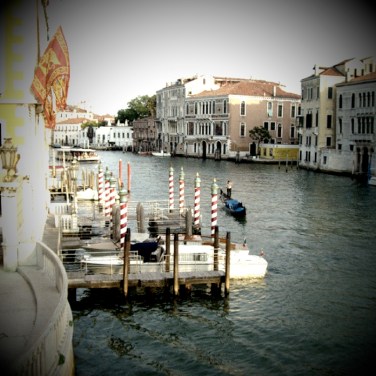
CameraBag_Photo_1002I have always loved reading and watching mystery stories. I had read Donna Leon’s entire Commissario Brunetti series and its magical Venetian setting prompted me to suggest to Jamie that we visit Venice on the way back to LA from Forte dei Marmi one August.
“Not Lake Como?” he asked.

“No, Venice.”

“London?”

“No, Venice.”

“Lake Garda?”

“Is there something you’re not telling me?” I asked.

“Danny says that the canals smell.”

“Not anymore. Besides, at low tide, pretty much every place near water smells.”

“The mosquitoes might be bad, too.”

“So I’ll buy repellant. They’re deadly at your mother’s house in East Hampton, too, but we go there. Why don’t you want to go to Venice?”

He signed. “It’s not that I don’t want to go, exactly.”

“What is it exactly?”

“I want to go to Lake Como.”

“Next year. You chose Florence last year. And Siena the year before that. “

“You liked both of them.”

“Yes, I did, but it’s my turn. This year it’s Venice. It is supposed to be beautiful and besides, we can go to Murano and buy a chandelier for the dining room.”

Eventually Jamie warmed to the idea, especially after he learned that he could use some of his zillion Hilton points to stay for free. The thought of finally covering the hole in the dining room ceiling where the wires hung out appealed to him, too. (To his chagrin, it had been that way for seventeen years because I refused to buy anything other than something magical and we had not yet seen anything that met my indistinct, yet immovable, specifications.)

In late July, I was watching my friend Charlotte paint a rug on our kitchen floor when my phone pinged with an email confirmation from the Hilton Molino Stucky. Following the links I learned that it was a beautiful building, a disused pasta factory on the island of Giudecca rehabbed into a luxury hotel. It looked terrific, with Venetian glass decorations, a rooftop pool, and quarter-hourly boat service across the lagoon to Venice. After viewing the site I called Jamie at work.

“Hey, did you look at this hotel’s website?”

“What hotel?”

“The Hilton in Venice.”

“No, I just called Hilton Points and they booked it. Why? Is it awful? If it’s awful I’ll cancel and call American Express and tell them to move us to the Danieli”

“Ooooh, the Danieli. Dickens stayed there.”

“Would you rather be there?” He sounded hopeful.

“Now I can’t decide. I want to go to the Danieli but this Hilton is a redone industrial space and it looks really cool. Plus it’s not in Venice, exactly; it’s on the island of Giudecca, an old shipyard town across the lagoon. There are other small factories, too; Fortuny’s workshop is there – right next to the hotel. And Cipriani is at the other end of the island. “

“I don’t know. Maybe I should call AmEx.”

“No, we can stay at the Danieli another time. This place looks like a good choice.”

He said nothing. That meant vacillation.

“Jame, do you remember the first time we went to New Orleans?”

“Of course. Why?”

“Remember I chose the little back street hotel that used to be someone’s home and it was jewel-box perfect? So perfect that Food & Wine was there photographing it? And we returned to stay there six times.”

“What’s your point?”

“That we should follow my antennae. This place is cool. It’s interesting. It’s unique. If it’s not, you get to say ‘I told you so’ all the way back to LAX.”

“That’s not much; we sleep most of the way back. I get to say ‘I told you so’ for longer than that.”

“Okay, until your birthday in September. Deal?”

“Deal.”

The day finally came. After taking a car service from Tuscany to the Piazzale Roma, we found a water taxi. The pilot stowed our luggage as we made our way into, then out of, the cabin, preferring to stand in the sunshine at the front of the boat as it sped across the water toward Venice. I love Italy; I think it’s the most beautiful country I have ever seen, but the natural beauty surrounding us dazzled even me. The distant city glistened in the golden rays of the late afternoon sun while the water sparkled like sapphires as we glided through it, spray dampening and curling my hair.

The hotel was everything I had hoped for and more. Hilton had upgraded us to a suite with a dining area, two bathrooms, a king-sized bed, and stunning views. Closing the heavy wooden door after the bellman, Jamie wandered around the dining area and into the lounge. Flopping on the sofa, he gestured at the chandelier hanging above the dining room table. “That’s pretty,” he said. “I wonder what kind it is.”

I kicked off my sandals, pulled out a dining chair, and climbed atop it to examine the fixture closely. It was thick translucent glass with serpentines of gold swirling diagonally across it. Within the gold curlicues were alternating designs of heart and teardrop shaped figures accompanied by an almost thistly pattern, then surrounded with still more swirls. It hung from silken cords and was held in place by hand-tied knots accompanied by amber glass beads. From the center hung a large, amethyst, glass bead with a silken tassel waterfalling from it.   It was elegant, sophisticated, ascetic, and romantic simultaneously. I turned it slightly and read the word close to the top.   “It’s Mariano Fortuny!” I exclaimed, surprised. I knew he had been a fabric designer who also had created theatre sets, but had no idea that lighting was also among his talents.

“What do you think about something like that for the dining room?” Jamie asked.

“You mean instead of a Murano glass one? But I already made the appointment at Gritti for the day after tomorrow.”

“Yeah. We can still go to Murano and look if you want, but I think this may be the one. Besides, didn’t you say Fortuny is next door?”

I nodded and climbed down.

Jamie looked out the window at the darkening sky and glanced at his watch. “Let’s unpack and go eat,” he said.

“Italians don’t dine this early,” I reminded him.

“No, but their lunches stretch on forever. Come on.”

By the time we had put away all of our clothes and showered, the sky was a dark, inky, blue. Jamie was watching the BBC World News as I entered the living room in a red linen dress. “Do you want to eat in the hotel?” I asked.

He pressed the Off button of the remote control and shook his head. “No, not really. Let’s go look at this island. It’s what we came here for.”

The lobby was awash with clear, white, light spilling from sparkling Murano glass fixtures. We exited the hotel through the big front doors, then walked down to the boat pier and hung over the railing. Venice glittered in the distance. Jamie walked along the pier to the left. “This is the end of the island,” he called.

I nodded and pointed behind me. “Everything is that way.”

He retraced his steps. “What’s everything?”

“I don’t really know. I just know that that – “ I pointed at a dark building – “is Fortuny and down at the other end – “ I gestured “- is Cipriani.”

“What’s that?” Jamie pointed to what looked like a white tent at the edge of the lagoon wall. It was hung with glimmering light and appeared filled with people.

I shook my head. “I donno. Let’s go see.”

We crossed over the small canal on a sloping bridge and began walking along the paved path atop the sea wall. Delicious aromas of perfectly cooked food wafted through the air, enticing us before we were anywhere near the tent. I pointed to a discreet sign. “Cipriani Dolce,” I said. “It must be a satellite of the hotel.”

“It smells great,” Jamie said tugging at my hand to walk faster.

“But Dolce means sweet. You don’t suppose it’s just desserts, do you?”

Jamie sniffed. “Doesn’t smell like it.”

Within minutes we had reached the tent. The maitre d’ greeted us enthusiastically and seated us at a tiny table covered with a white linen cloth and gleaming flatware.

“Do you want a Bellini?” Jamie asked.

I shrugged. “I don’t know. I have never had one. What is it?”

“Prosecco and white peach puree,” Jamie answered.

“Oh, yeah; that sounds perfect.”

We ordered drinks, and Cipriani’s famous tagliolini with ham in a rich Béchamel sauce. We sat there for over two hours, talking, laughing, kissing, and planning our days in Venice while we drank one Bellini after another.  Finally, Jamie paid the bill and we began our tipsy stroll back to the Hilton. I wobbled on my spike heels and, leaning on Jamie’s shoulder, removed them, allowing them to dangle from my right hand. Giudecca was all but silent. The indigo sky was awash with stars and a gentle sea breeze sighed and surrounded us as we walked.

We paused in front of the dark Fortuny building to read a sign posted on its door stating that while it was closed for the summer, products were available at all Venetia Studium.   “Let’s go to the shop tomorrow and buy a chandelier,” Jamie said as we began the climb up the little humpbacked bridge just before the hotel forecourt. I nodded.

Jamie stopped at the highest point of the bridge. Looking around at the endless sky, water, and distant glowing city, he squeezed my hand. “Good choice, he said. “Lake Como can wait until next year.”

Jarndyce and Jarndyce in the Empire State

IMG_9840

2474 Grand Avenue, Apartment 18 C, Bronx, NY 10468, halfway between Fordham Road and West 190th Street, was my family’s home from 1939 until the mid-1970’s. It’s where I lived after my mom brought me home from Fitch Sanitarium in October 1959. It and my grandparents’ business, an electronics sales and repair store called DeVoe Radio & Electric, on Fordham Road, are the places that I have always associated with my family history in New York. So it was a surprise when my dad phoned me one evening to tell me of a conversation he had had with an Unclaimed Property and Estates lawyer for the State of New York.

“Grandma owned a house in the Bronx,” he said.

“Where?”

I could almost hear him shrug through the telephone line. “I don’t know, exactly; somewhere near the intersection of 161 Street and Southern Boulevard.”

I thought. “Off Jerome Avenue?   Kind of near Yankee Stadium?”

“Kind of but I don’t really know.”

“If she owned a house, why did we live in the apartment? Did someone leave it to her and she was unaware that she owned it?”

My father paused before answering. “Maybe, but I can’t believe that would be true, not least because she would have told me. Certainly after Grandpa died, she absolutely would have told me for estate planning reasons if for no other.”

“Since when had she owned it? Maybe she didn’t know.” My grandmother had suffered a series of strokes and had been unaware of many things for quite a while.

“Apparently, it was left to her and her brother jointly in the 1940’s and, at some point, was lost for unpaid property taxes.”

That meant she had been aware of it since she hadn’t been ill until the early 1980’s. “How did you learn about this?” I asked.

My father relayed the story of the lawyer who had contacted a cousin, apparently using the telephone book: he had been the only potential heir the lawyer was able to find because the rest of us have different surnames or unlisted telephone numbers.   The cousin had advised the lawyer to speak with my father, the person with the longest memory for family history. My grandmother’s father, Jack Roth, had bequeathed a house and lot he had owned and utilized as a rental property to my grandmother and her brother, Benjamin. At the time of Roth’s death, my grandmother’s brother had long since died of tuberculosis, leaving her the sole beneficiary of the bequest.

“So you never lived in the house as a child?” I asked my father.

“No,” he replied. “I never even heard about it. We lived in an apartment on the Grand Concourse when Grandpa’s father lived with us when I was very young, then moved to Grand Avenue after he died because the Concourse apartment was too big for us.”

“And she never mentioned it?”

“No, that’s the mystery of it all.”

“Who lived in the house?”

“Some cousin’s on Jack Roth’s side of the family but Grandma and her brother didn’t know them because remember that her father left them when she was eight years old.”

“So how did he come to have the money to buy a house for other people to live in when he couldn’t even support his family?” I knew from my grandmother’s stories that her father disappeared from her life completely leaving neither a collar button nor a dime behind for his family.

“Oh, he started a trucking business at some point, years after Grandma’s mother divorced him for desertion, and did pretty well for himself,” my father answered.

“Hm. But not so well that he could look after his children,” I retorted.

“Apparently he started another family; he turned his back on Grandma and Uncle Benjamin along with his first wife. He never saw them again, never even sent a birthday card. That’s why it’s so odd that he left her the house.”

“Deathbed guilt?” I hypothesized.

“Maybe, but I can’t figure it out. All I can get from the lawyer is that the house’s title was transferred to my mother and it was rescinded a few years later for unpaid property taxes.”

“And went where?” I asked.

“The title went to the City of New York,” he answered. “And it owned it for a while then sold the property and that is the money that the State and City have determined belongs to Grandma.”

“How long ago did they sell it?” I asked.

He snorted. “Decades, which is what makes it so interesting that they are just looking for her now.”

“She has been dead since I was a sophomore in college, 1978,” I said. “What were they waiting for?”

“I don’t know. Apparently they are cleaning out old files and attempting to pay long-delayed money to the heirs.”

“So how much is there?” I asked.

“A couple of hundred thousand dollars before taxes and fees,” he answered.

“So how do you get it?”

“I submit paperwork proving that Grandma was my and Uncle Carl’s mother and that her brother died leaving no heirs.”

“How do you prove that?”

“Well, I have my birth certificate so I have to obtain a copy of Uncle Ben’s birth and death certificates and presumably they will accept that since he died so young he left none.”

“Hmmm. Then what?”

“Your cousins provide copies of Uncle Carl’s birth and death certificates, plus their own birth certificates, and they will receive his share. All of that comes after I provide copies of Grandma’s and Grandpa’s birth and death certificates and wedding certificate.”

“Gee, that’s a lot of paper, but it’s still pretty cool. How long do they suppose this will all take?”

“Probably about a year, maybe a bit longer.”

“That’s something nice to look forward to,” I offered.

He sighed through the phone. “I won’t hold my breath. But what matters more than the money is that my mother kept something from me. Especially when we did their estate planning and . . .” His voice trailed off.

I didn’t know what to say that would comfort him. “Maybe she and Grandpa couldn’t afford the property taxes. Maybe she didn’t want the house. Maybe it was too little, too late from the man who left her.”

“Maybe.” He sounded unconvinced. I got the feeling that my father didn’t really want the money, either, whether because it came from a disreputable source or because it was tangible proof of a family secret, I don’t know.

About a year later, I asked him on the phone one night. ”Hey, did you get the money yet?”

“What money?” he asked.

“Jack Roth’s house money.”

“Oh. That. No.”

“Why not?”

“It took over three months to get the birth and death certificates for Grandma’s brother, Ben, and then when they realized that at the age of thirteen he may have been able to impregnate a girl, they began an entirely new heir search for his children.”

“He didn’t have any!” I exclaimed. “Grandma always said that she had no living relatives except Aunt Lillie on her mother’s side.”

“I now, but they don’t believe me,” my father replied.

“So where are you now in the process?”

“Waiting for the City and State of New York to agree that there are no other heirs.”

“Youch,” I answered. “Considering it took them decades to find you, this could go on forever.”

“In which case you had better begin getting all of the family paperwork in order because you may have to continue this after I die.” He sounded disgusted, although whether by the process, the delay, or his mother’s secret I still didn’t know.

About eighteen months after that conversation I was wandering through a department store with my mother. “Whatever happened with that money that Daddy is supposed to get from New York?” I asked. “Has he received it yet?”

“Hell, no,” she replied refolding a sweater she was considering buying. “We just heard from them last week that there are no heirs on Ben’s side, so now they are back to your father and your cousins.”

“So where are they in the process?”

“They are verifying that the Carl Koster who served on the USS Stribling during World War II is the same Carl Koster who is the heir of Jack Roth.”

“Why does that matter?”

“Apparently your uncle lied about his full, legal name and age in order to enlist and all of the paperwork doesn’t match up.”

I was baffled. “Why does it have to?” I asked. “He has been dead for years. Is it so his children get the money?”

“No, it’s because he died penniless and intestate and the VA paid for his funeral and now it wants to recoup its costs if he is set to inherit something posthumously.”

My mouth popped open and I stared at her. She shrugged and waved a hand. “I don’t want to think about it,” she said. “Let’s go get lunch.”

That was in July. A year later, I was helping my parents consolidate and destroy old files so they could dispose of an archaic, dented, metal filing cabinet. “Do you want this?” I would ask about each file folder I pulled from the damaged drawer. I pulled out a green hanging folder, about three inches thick, and stuffed with papers. “Do you want this?” I asked as I handed it to my father.

He looked and sighed. “Unfortunately yes. That’s the property file.”

“What property file?” I asked. “You sold the beach houses years ago. You don’t need that, anymore.”

“Not the beach property.” He responded. “It’s the Southern Boulevard property that belonged to your great grandfather.”

“Dear God! Are you and New York still playing around with that?” I exclaimed.

“New York is,” my father replied. “I am still trying to figure out why my mother owned property she didn’t pay taxes on and then never told me about.”

I didn’t know what to say. “Maybe she forgot about it,” I suggested lamely, looking into his blue eyes.

He refused to meet my gaze. “Maybe,” he repeated.

Last Christmas I saw the file on an end table in my parents’ living room, but didn’t say anything at first; that night, before leaving, I pointed to it while my father and I watched the eleven o’clock news. “Still?”

“Yes, still.”

“Holy shit. This inheritance is Dickensian in its length. What are they waiting for now?”

“There has to be a hearing. All of the paperwork is presented and a judge agrees to release the funds to the heirs, however, he could decide to release it conditionally.”

“What kind of conditions?” I queried.

“He could put a ninety or one hundred-twenty day hold on the money so no one may touch it immediately or require the heirs to post a bond for the full amount.”

“What the hell for?” I exclaimed. “Surely they don’t think there are any other heirs at this point. And even if there were, they have been holding the money since before I was born; surely they have earned proceeds on it during that time. Those proceeds must be large enough to cover its loss.”

My father shrugged. “It doesn’t even matter; it’s found money and found money I don’t even really want.”

“But you could use it,” I pointed out.

“I could always use it since your mother and I are long retired,” he agreed, “ but I don’t like what it represents.”

“What does it represent? Some bastard’s payback after deserting his family,” I exclaimed.

“Yes, money that someone seemed to believe would make everything all right,” he answered.

“So what? He’s dead. And you’re not. Linda’s not. Cynthia’s not,” I replied, naming my cousins. “They might like to have the money.”

“Their mother didn’t lie to them!” he blurted.

“Your mother didn’t lie to you,” I answered after a moment. “She just didn’t tell you everything about her own, personal life.”

He stared at the television. “Her own, personal life,” he repeated. “The mystery of her own, personal life.”

“Don’t you and Mommy have interior lives that you don’t share with me?” I asked. “It’s no different.”

He stared at me, then clicked the remote to make the news broadcast louder and turned away.

It is over a year and the money has not yet been released to the heirs. My parents are in their eighties so, if it is coming, it had better be soon; they could use it, they would enjoy it, and it is legally theirs. Besides, I don’t want my heirs to begin the process all over with another collection of certificates in thirty years’ time.