I’ll Never Do This Again, I Swear.

images

In LA you can always tell when the apartment dwellers are moving on because the narrow sidewalks in front of the low-slung walkups with matching carports are crowded with piles of whatever cannot be taken to the next, maybe even smaller, place with signs reading “Sidewalk Sale.” In the NYC metro suburbs, however, we have actual garages and wide driveways to fill with our castoffs so our sidewalks remain clear.

All of my friends like garage sales, both going to them to find some special piece to fill the empty space on the kitchen display shelf and having them to sell the stuff that they no longer want to dust. Neither my mother nor my husband has ever liked them – both believe that filling one’s home with someone else’s driveway castoffs is a recipe for disaster – so I have neither gone to nor planned any.  Until today.

Today was my first and probably last garage sale. The preparation took forever – sorting through closets, boxes, and bags; organizing photos in albums and frames; deciding which books I may read again and which can go to new homes; loading all of the cds into ITunes in order to clear the clutter by selling them. And I stuck a price tag on every item because as one of my friends told me regarding her experience with signs falling or getting blown away, “people need to know how much every item costs so they can complain to you about it”.

Then I ran afoul of the local constabulary by taping the sign advertising my sale to a utility pole. I said to the policeman, “But I went on the town website to see whether there are any ordinances or restrictions on garage sales and there is nothing posted about that.” “Remove the sign,” he replied unsmilingly, so I did.

We had planned to open at 10 am but people began wandering around at 8, poking through baskets and bins and all but shoving us out of the way to dig for buried treasure, none of which was there, as mine was a rather utilitarian sale, and not one with Great Aunt Jenny’s unwanted sterling silver flatware up for grabs.  Everyone wanted costume jewelry. Everyone wanted Legos. Everyone wanted everything for less than it was marked.

“How much is this cd?”

“It’s got a sticker on it. See? One dollar.”

“Can I have two for one dollar?”

“No.”

My favorite person was the man who offered twenty-five cents per cd for all two hundred of them. I refused. He didn’t seem too surprised. Probably a dealer, my husband said.

Then there was the query about the shoes. “How much are these shoes?”

“Ten dollars.”

“I’ll give you five.”

“No, thanks.”

“But I don’t know whether they will fit me for that price.”

Evidently they would fit for a lower price.  “Try them on,” I suggested.  He walked away scowling.

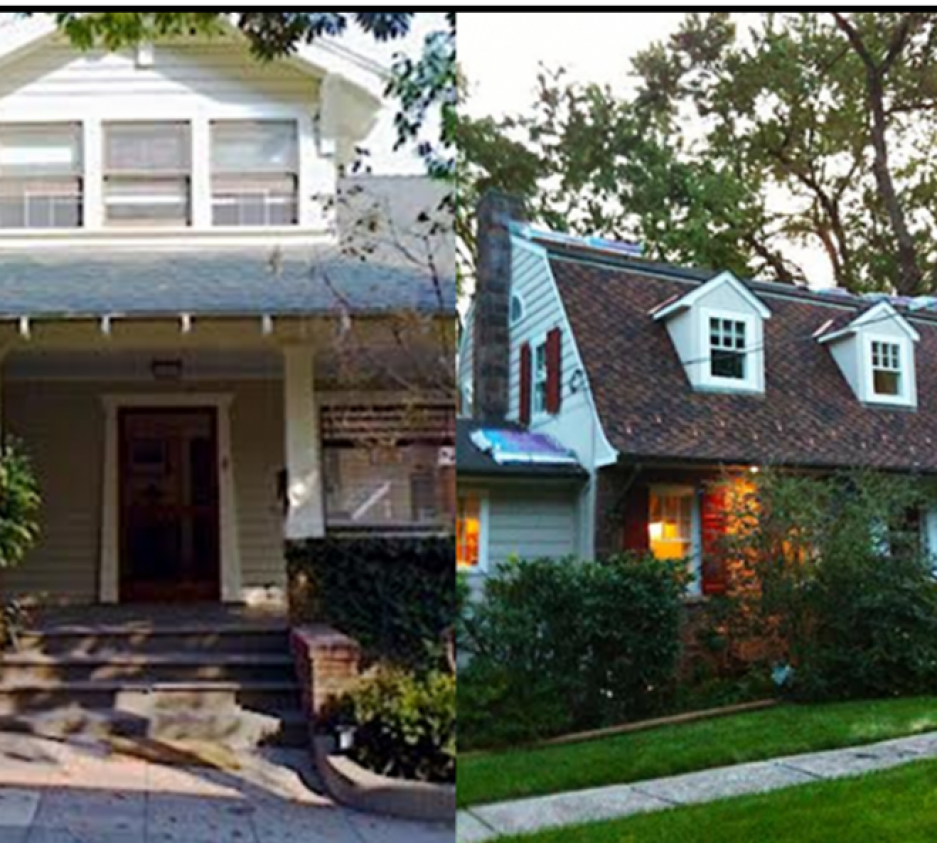
Until today I had no idea that garage saling is such a big hobby that everyone – from seven year old girls to elderly men with canes – does it. I have no idea why, except maybe it’s the thrill of the hunt, the hope of finding the green mermaid Wade Whimsie that you need to complete your collection. I also think people are voyeuristic; I cannot count how many people commented that they came because they live in the neighborhood and had always wanted to see our house up close and look at the back garden. (It’s a traditional 1920s Dutch Colonial house on an uncommonly large lot.)

After this experience, I have concluded that my mother and husband are right; displaying and flogging unwanted appliances and surplus cat carriers is a hell of a way to spend a glorious summer day. If it hadn’t been my mismatched coffee mugs and old Christmas ornaments on those tables, I certainly wouldn’t have been here. And it was barely worth it; the amount of time I spent working on it divided by the amount of money received comes to pitifully less than minimum wage.  Maybe I just wasn’t divesting myself of things anyone wanted – like my grandmother’s mixing bowls that one friend asked if I planned to sell or my French Bakelite jewelry that remains in my drawer despite repeated entreaties.  My stuff – books, cds, mugs, baskets – is out of favor with the salers. I think I will call the Goodwill or Vietnam Vets the next time I clean. That way will do good for all involved; someone else does all the work and receives the benefit and my basement is still tidy.

Liberte, Egalite, Fraternite, Cafe au Lait

DSC_0891The week after I finished graduate school, my husband, Jamie, and I went to Europe together for the first time. Excluding our honeymoon years before, this would be our first really long trip and, as my overly romantic imagination took hold, I envisioned us wandering arm in arm through moonlit Roman ruins; munching les marron glaces at Laduree’s tiny bistro tables; and elegantly sipping steaming Lapsang Souchong at Brown’s Hotel. So powerful was this vision that I completely ignored what I already knew about the reality of travelling with Jamie; specifically, I read the tour books and look at the sights while he clutches a telephone to his ear, talking to his office as he unconsciously tidies things. Years earlier we had accompanied my parents on a cruise to Bermuda. Since there were no international cell phones then, Jamie spent an entire day on the dock in Hamilton talking on a pay phone on the pier. As I skipped away for a day of shopping and eating with my mom and dad, the last thing I noticed was his saying “No, Kenny, I think if you open the bids again, you’ll find that . . . “ as he dabbed idly at a barely-visible Diet Coke spot on his khaki shorts.
I have never understood his affection for telephones or cleaning. Being rather a Luddite, I didn’t get my first cell phone until long after they’d become common. Perhaps my husband’s addiction to it put me off.
While I suspect that the telephone thing is work-based, the cleaning is something he does reflexively. Most of the time it seems harmless, quirky: sometimes it’s even been charming, like the sunny July morning my visiting childhood friend, Patti, excused herself to go to the bathroom during breakfast. By the time she returned, Jamie had cleared the table, loaded the dishwasher, and scrubbed the griddle, all with his trusty Motorola Razr pasted firmly to his left ear. “Seriously, Danny, you can’t honestly think that . . . “
The days passed, our suitcases were packed, and the morning of our departure arrived. My heart pounding, we boarded the plane to London. During the flight Jamie didn’t use the Airphone at all but he did tidy all of the newspapers on the steward’s cart. As we began navigating our carry-ons down the Jetway, however, his cell phone rang and it took repeated scowls from the Immigration officers to convince him to disconnect. It rang again as we settled into our black taxi and Jamie chatted throughout the drive from Heathrow to Mayfair. As he executed the U turn on Carlos Place in front of our hotel, the driver – no slouch on the mobile phone himself, by the way – commented wryly that he hoped I’d be okay visiting the Tower and Harrod’s on my own since my husband would no doubt be up in our room talking on the landline, having exhausted his phone’s battery.
We wandered through European capitals, Jamie and I, chatting and reading, folding and plumping. The evening before we were scheduled to leave Paris, Jamie prowled the room, hunting for errant objects with his cell scrunched under his chin. I reclined against pillows on the bed and watched the 1936 Warner Brothers classic Charge of the Light Brigade with Errol Flynn dubbed to sound like Yves Montand.
We needed to arrive at the station no later than 7:15 a.m. to retrieve our reserved tickets and make our way to the carriage of our 7:45 a.m. train. Because I am not at my most alert in the morning, I had taken the linen jacket I intended to wear and purposefully laid it across the back of a chair before I retired. The chair stood next to the door. Regardless of my level of catatonia, I would see it..
Just after our 6:00 a. m. wake up call Jamie shoved me toward the shower and called Room Service for café au lait and pastries. Despite the caffeine fortification, I dawdled and Jamie prodded me to hurry. Exiting into the misty Champs Elysees morning, I grumbled about the chill air. Jamie assured me I’d find hot coffee waiting at the station. Comforted, I promptly fell asleep in the back of the tiny taxi. By the time we’d reached the station, however, I had awakened shivering. I searched my carry-on bag for my jacket.
“Did you pack it in your bag?” I asked Jamie as the taxi drove through the crescent to the wide-open glass doors of the Eurostar terminal.
He twisted his neck to hold his phone while he spoke to me. “Hold on, Kenny. Pack what?”
“My jacket. My beige linen Moschino jacket.”
When he didn’t answer, I poked him. He shrugged and gestured to the metal object adhered to his ear. He continued talking until the taxi stopped at the doors, then disconnected and glanced at the meter.
“Where’s my jacket?” I asked.
He counted Euros. “Do you have any money?”
I emptied the front pocket of my jeans into his waiting palm. “Here. Where’s my jacket?”
“I dunno. Did you take it out of the closet?”
“It wasn’t in the closet. I threw it across the back of the blue chair by the door because I knew I wouldn’t see it otherwise. “ I could almost feel the little cartoon light bulb suddenly switch on above my head. “You hung it in the closet, didn’t you?” I cried accusingly. “Last night when you were on the phone with Kenny you tidied it away! We have to catch a train in twenty minutes and my jacket is in a closet in the hotel!”
He swung open the taxi door dragging the carry-ons behind him. “Call the hotel and tell them to send it to Jose and Diana’s house. Use my office’s Fed Ex number. I have to call Kenny back.”
After paying the driver and claiming the tickets, there was barely enough time for my errand. Fed Ex number and hotel receipt clutched in my sweaty palm, I scurried down the train steps and looked around nervously for an old-fashioned public telephone sign. Finally locating it on the outer wall of a tiny coffee bar, I trotted into the smoky room. Reaching for the handset, I ran my eyes all over the phone’s body looking for the coin slot. With a shock I realized that it didn’t accept cash, only phone cards. I turned and dashed out of the warm, dark bar and into the bright, chilly station searching for the tabac stand. There it was, against the far corner. I trotted toward it. Facing the clerk squarely, I tried to act out my request as I fumbled with my poor French. “Je suis . . . une telephone card.”
Her brown eyes widened.
“No? Um, voulez vous une telephone card?” She frowned. Apparently that wasn’t right, either.
I mimicked dialing and chatting gaily. She cocked her head like a puzzled squirrel. Nearly frantic, I lapsed into Italian, the only foreign language I know. “Per favore, vorrei comprare una carta del telefono.” She smiled and answered something like, “Vous voudriez . . . une carte de telephone” lilting at the end so I assumed it was a question. I nodded. She asked something else and the blankness of my expression must have assured her that there was no way I knew the answer to that one. She repeated it, louder. Realizing that raising one’s voice at a foreigner seemed to be a universal reaction to coping with one, I chewed my bottom lip and nodded slowly, hoping that was the correct response. She sighed, shook her head, and turned to a locked cabinet where she slid in the key and chose a green telephone card with a French cartoon character printed on it. I held out all the money I had left. She picked out the price of the card, placed in it my hand , and then smiled.
I turned and raced through the station back to the smoky bar. Yanking hard on the glass door handle, I heard a loud, metallic binnnnnnng-bonnnnnnng. It reminded me of the televised Avon Cosmetics commercials from my childhood. Nervously, I laughed aloud at the thought – Avon Ladies in Paris – and grabbed at the telephone handset. I had no idea how much time had elapsed, but connecting to the concierge, waiting for the head of Housekeeping to travel to our room and retrieve my jacket, and then verifying the Basel address and the Fed Ex number, seemed to take hours. I guessed I was safe, though; I hadn’t heard the Basel train called.
I exited the café and turned toward the track where my train was . . . no longer waiting. Disbelieving, I ran along the empty platform, dodging suitcases, strollers, and other people. I really needn’t have hurried since I could see the train’s distant lights as it turned a curve about a half-mile away. Realizing that the Avon Lady sound had probably been my train’s departure signal, I slid onto a cold wooden bench and considered my situation. A tear leaked out from under my lashes. Another one followed. I wiped them away with the backs of both hands (my tissues were in my tote bag on the train) and, feeling distinctly like Lucy Ricardo, I decided I’d better find the stationmaster.
The office was at the top of a flight of metal stairs. The stationmaster was a very kind man; after listening politely to my admittedly ludicrous tale – preoccupied husband; forgotten jacket; no phone card; no ticket or passport, either (both were with the Kleenex in my tote bag on the train), his only response was a small sigh “I am sorry to hear that, madame, however, you are in luck because there is another train in three hours’ time. We simply have to get you on it. Please sit down and allow me to assist you.” He paused and gestured to the blue plastic chair in front of his desk and pursed his lips slightly. “I know what we will do. I will radio the conductor on your train and ask him to verify that your husband and your ticket are indeed on it. The conductor will then assure your husband of your safety.” He slid a small pad of paper and a pen toward me. “Now if you will please write out for me your name, your husband’s name and the location of your seats.”
When I was done, he lifted one of the many radios that cluttered his desk and spoke rapidly to someone in French. He listened to the response then turned back to me. “The conductor says that he just passed through the carriage containing your husband and that he was talking on his mobile phone but that he had two tickets in his hand. In a few minutes, when he finishes his round, the conductor will return and ask your husband to see your passport. Then he will confirm your identity and assure your husband of your safety. Afterward, we will issue you a new ticket. Please make yourself comfortable. We have only a few minutes to wait.”
My husband was talking on the telephone. Surprise. No doubt he’d be tidying the carriage in a few minute’s time.
I stared idly through the window while we waited. When the radio crackled in garbled French, the stationmaster lifted it to his ear, listened, looked at the pad, and then smiled. “Now we will provide you with a new ticket and somewhere to wait until the next train.” He reached for a cell phone and dialed. After a few seconds he began chattering quickly. I understood almost nothing of what he said, just “Americain” and “mal place”. In another few seconds, the stationmaster disconnected the call and rose. “My assistant is coming. He will provide you with a new ticket and remain with you until your train boards. In the meantime, I must go to the train-shed. Please remain here in comfort. If you will excuse me.” He was gone.
I sat and chewed my right thumbnail pondering my own idiocy. In about ten minutes, the glass door opened and a young man entered. “Are you the lost American?” he inquired politely.  Now I had a title.
The assistant stationmaster asked me to wait while he completed a few of his duties. Since I had so much time, I took a taxi to the hotel to retrieve my jacket then met the assistant stationmaster again when he came to reclaim me. Since it was time for his midmorning break, he led me to a cool Parisian bar where he bought me a pain au chocolat and café au lait, then leaned against the scarred zinc counter and introduced me to his friends as the lost American. At the correct time, he escorted me to my train and asked the conductor to be sure that I got to my seat safely. He probably also suggested that it would be best if I didn’t leave my seat until the train stopped in Switzerland, although I can’t be sure of this because I didn’t understand their conversation held entirely in French. Regardless, I made the trip to Basel in safety and comfort, albeit without my second honeymoon groom.
In retrospect, it all worked out fine. True, I missed the romance of a train trip with Jamie but I had a Parisian adventure that I’d never have had any other way. Plus I learned a few things; I learned that I can survive with no passport, no money, and no facility for the local language. And I learned that all my years of living inside books wasn’t wasted; Tennessee Williams really was correct about the kindness of strangers.

Rated G

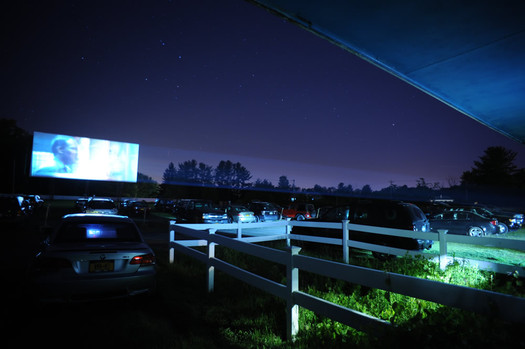
IMG_7983One Saturday night in August 1973, my mom and dad joined Aunt Fay and Uncle Nick on a double date to Hathaway’s drive in movie theatre in North Hoosick to see the popular gangster film The Godfather.   Because they returned late, everyone was in bed, forcing them to share their thoughts about the movie the next morning. My father raved. It was brilliant, so complex and evocative of its time and place. My mom agreed; the story and characters were so realistic yet the dialogue was so full of poetry. Listening closely to the film review, my grandfather nodded thoughtfully.

My parents returned to the city later that day, leaving me upstate. The next Wednesday evening after dinner, my grandfather turned to my grandmother.

“Hey, Ruthie, let’s pack up the Peanut here and go see that movie the kids were raving about. You know, the gangster film.”

My grandmother looked up from her crocheting, frowning, and nodded slightly, yet pointedly, at me, Peanut (so nicknamed because I am the youngest grandchild), lounging on the sofa. “I don’t know. I talked to Fay about it and they say” –  here she stage-whispered “the word ‘fuck’ in that movie.”

My grandfather raised his left arm as if to push away her concern. “Peanut has heard it before. She just heard it from you. Come on, let’s go.”

Grabbing sweaters we set off in my grandfather’s maroon Delta 88 the few miles to the theatre. It was dusk by the time we made the left turn by Delaney’s Hotel, and we could see that the line at Hathaway’s was so long cars were pulled over onto the side of the road, trying not to block the entrance to the gas station or Tate’s Diner as they inched forward to the box office; by the time we reached the ticket booth, The Godfather tickets had all sold out, leaving us with a Faye Dunaway and George C. Scott film about a woman oil wildcatter called Oklahoma Crude. My grandfather sighed with disappointment and turned to my grandmother. “Well?”

“We’re here now, Kenneth, no point in going home. We’ll just watch the George C. Scott movie and see the gangster show another time. I like George C. Scott. Remember how good he was in that Patton?” Her tone made me think she was placating him because, however much she had or had not enjoyed Patton, she was pretty happy that The Godfather was off the menu; she had no intention of taking her younger son’s youngest child to a movie in which dirty language was bandied about.

“All right. But we are seeing the gangster show next week,” my grandfather grumbled, handing the money to the teenage girl in the booth.

We followed the other cars into the rutted field and berthed in our allotted space. As my grandfather adjusted the silvery speaker on the driver’s side window I went to the concession stand for popcorn and soda. Returning, laden, I plopped in the middle of the back seat and leaned forward between the armrests to listen to the piped in music until the graying sky had turned a bluish-ebony and the movie could begin.

I don’t actually remember much of the film. I just know that it was going along pretty well until Faye Dunaway’s character had to explain to someone about why she felt no need of a man to help her hold onto her oil-rich land while the big oil companies plotted and schemed to steal it from her. She didn’t want a man, she announced. She was prepared to do everything a man could do in the oil fields and beyond; in fact, she concluded, “if I had a dick I could fuck myself, too!”

My grandmother gasped, then shrieked. She spun in her car seat faster than I had ever seen her move and before I realized what had happened she clamped both hands on either side of my head with a viselike grip, squeezing my brain to near pulp as she covered my ears. “Kenneth!” she howled. “That word! There’s that word!” My grandfather stared at her wordlessly for a minute, and then said softly, “Ruthie, let go of the kid.”

When she finally released my head, I reached up and tentatively tried to separate my earflaps from where they had been all but embedded in my skull. My poor grandmother. She had so liked George C. Scott that she completely forgot the salty language he had used as General Patton and, having never seen Bonnie and Clyde, had no idea who Faye Dunaway was. She was quiet for the rest of the night.

We never saw The Godfather that summer. In fact, I didn’t see it until it was released on VHS, at which point, I realized that the dialogue contains very little swearing and no character ever uttered the dreaded “fuck” at all. I don’t know whether my grandfather ever got the chance to see it, as he died before home video technology was available.

I think of my grandparents every time that movie comes on TV.  Last summer, seeing it on a pay channel, I commented idly about how it always reminded me of upstate New York and my grandparents.  This puzzled my father and I realized that my grandparents had never told the story, so I did.  In the telling it occurred to me that it says everything there is to say about my grandmother – to me, at least.  Her finer instincts to protect me were so strong, she never realized the insidiousness of the Trojan horse George C. Scott movie.  Evidently, if she really wanted to keep my adolescence rated G, she should have listened to my grandfather and taken me to the gangster film.

Hot Summer Nights

IMG_7972-3My favorite childhood companion was my stuffed Bantam Morgan dog. She was a third birthday gift from Uncle Fritz Danster, a Holocaust survivor and professional photographer. I loved my parents, my cousins, and my best friend, Patti Reyman, but Morgan was my constant companion.

It was early July, 1963; I was not quite four years old. My parents had gone away for a week’s vacation leaving my sister and me with our grandparents in the city. We had driven up the country (our phrase for the vacation house in upstate New York) for the weekend. It was late and I was in bed; I was supposed to be asleep but between the relentless heat and the sound of the TV I couldn’t drop off. I reached for Morgan, and in pulling her closer to me for a chat, heard a snick sound – like something hard and plastic had hit the linoleum floor. Feeling Morgan’s soft face I realized with dread that the sound had been one of her black plastic button eyes falling off and disappearing, probably forever. She would now need an eye patch like the one worn by my cousin Karen to correct her lazy eye.

Filled with horror at my friend’s potential fate, I shrieked and burst into heaving, gulping sobs. Both grandparents stumbled over one another to reach my small maple bed. “What’s wrong?” my grandmother gasped in fear.

I continued howling. “It’s Morgan! She can’t see!” I held up my stuffed friend. In the glow of the bedside lamp, it was evident that one of the button eyes was indeed missing. My grandmother sighed in relief that it was the toy and not me. “Oh, is that all? The dog lost a button? We’ll find it and I’ll sew it on in the morning.”

Shocked at her callous dismissiveness of my friend’s suffering, I emitted another ear-splitting wail. “No! Now! She’s blind! She’ll fall out of bed ’cause she can’t see where she’s going! Now! We have to find it now!”

I was wide awake at this point; thanks to me, so was everyone else. With a sigh and a snap of the switch, my grandmother flooded the room with light from the overhead fixture and commenced the search while I clutched Morgan and snuffled.

It took about fifteen seconds to find the button; it had, after all, fallen right next to the bed and hadn’t even had the energy to bounce anywhere in the sultry night. My grandmother fetched her sewing box and, under my watchful gaze, reattached Morgan’s eye thus restoring her sight. Perhaps due to the drama, Morgan and I fell asleep right after the surgery.

I sometimes think of Morgan’s accident on hot summer nights; occasionally I think of it randomly when I see her perched on my bed. It’s been over fifty years since her brush with blindness and more amazing, even, than her miraculous recovery, is my grandmother’s reaction to her misadventure, specifically the speed with which she assuaged a little girl’s pain and fear by repairing her stuffed friend immediately.

I miss my grandmother and her trusty needle. She could fix lots of things; I could use her skill now.

Strawberry Fields Forever

Berries

When I was little, my family would leave the city on summer Friday evenings just before sunset, after my dad and grandfather returned home from work and it was no longer so hot outside. The drive upstate on the Taconic was boring so I often fell asleep.
Saturday mornings were busy and everyone had a task; the first stop for my grandparents and me was Grand Union in Hoosick Falls for the meat – chicken or steak – that my dad and grandfather would grill in the huge brick barbecue they had built years before. Next we drove to Faile’s Dairy in Cambridge for fresh eggs and heavy cream. My mom would grab my sister and head to Moses Farm Stand in Eagle Bridge for sweet peaches, firm-fleshed Jersey tomatoes, corn on the cob, and strawberries all picked earlier that morning.

I remember the strawberries best of all – plump, luscious, bright-red, and freckled. Soon they’d be swimming in a cold-water bath in my grandmother’s deep kitchen sink, then placed on a paper towel to wait while she mixed and baked an all-butter pound cake. Smelling the fruity berry scent and the rich aroma of the cake bought everyone into the kitchen. No one had the patience to wait until the golden cake was cooled and sliced into three equal layers or to watch my grandmother hand-whip the cream and spread it thickly, then dot it with the shiny red berries. She swatted away lots of probing fingers with her metal spatula while she assembled. Even though there were other things, delicious things, to eat before the cake, the highlight was my grandmother’s strawberry shortcake.

My grandparents are dead and their house long-sold. Faile’s Dairy is out of business. My sister and I are past middle-aged. But sweet, red, summer strawberries live on in my imagination and my garden.

Of Mothers and Books

lion

I am a second-generation story-hoarder. From as early as I can recall, my mother, a voracious reader, read stories to me.  We sat squashed together on the sofa or a park bench, transfixed by the tale, me following the print across invisible lines on the pages with my finger and squinting to see the relationship between the words and the pictures, as she read aloud in her smooth voice.  Once I asked her if she made up these stories and wrote them on the paper for me.  She laughed and said no, a special kind of artist did; they were called writers and the stories they created enriched everyone’s lives. I was impressed. Those people called writers caught magic with their imaginations the way my cousins and I caught lightning bugs in old jam jars.

When I was three, she took me on the subway from the Bronx to the main branch of the New York Public Library at 42nd Street, to get my first library card so I could join her in the pleasure of checking out books.  I remember climbing the great stone staircase of the Beaux Arts structure slowly, my short legs requiring two hopping steps to equal each one of her long-legged strides.  Of course, the fact that I peered over my shoulder continually, trying to look at the two enormous stone lions, placed like sentinels where the sidewalk met the stairs, and wondering what they guarded didn’t help my awkward ascent. The sheer majesty of the structure made me conclude that this building held valuable things and must therefore be a bank.

When we finally arrived in the cool marble lobby, I gasped as I saw what the unblinking lions were protecting.  The entire building was filled not with money but with books; I could see them from where I stood under the big chandelier.  I knew then why my mother loved this place; this was where those special artists wrote their ideas for the rest of us to hold in our hands and read.  Wandering through the aisles of the children’s section, running my sweaty finger along the plastic-wrapped spines of the Dr. Suesses and Beverly Clearys, it occurred to me why the lions out front were so busy they never closed their eyes; the stories inside of these books were beyond valuable, they were priceless. I knew because my mother had said so.

I caught my mother’s abiding passion for stories like DiMaggio caught pop flies – effortlessly. She encouraged me totally.  In elementary school, when I wanted to own every book in the monthly Arrow Book Club newsletter, my mother wrote the checks. Later, when I decided to try to scratch out my own magic by writing stories and poems, she purchased endless numbers of spiral-bound notebooks for me and convinced my grandfather to build floor to ceiling shelves in my room to hold my expanding library. When, at age eight, I succeeded in publishing my first poem in Highlights for Children, she crept into every pediatric office in the Fordham Road Medical Arts Building and swiped every waiting room copy.  And when I published my first story in a real hardback anthology, so certain was she that I would be a successful writer that she bought dozens of copies of it on Amazon.com and had me autograph them so she could give them to nearly everyone she knew.

I have begun to be what I wanted to be.  My stories have been included in national and international publications, although it isn’t yet time to quit the day job. And it is all because I was lucky enough to have you as my mother. So thanks, Mom.  I love you.

Lost New York

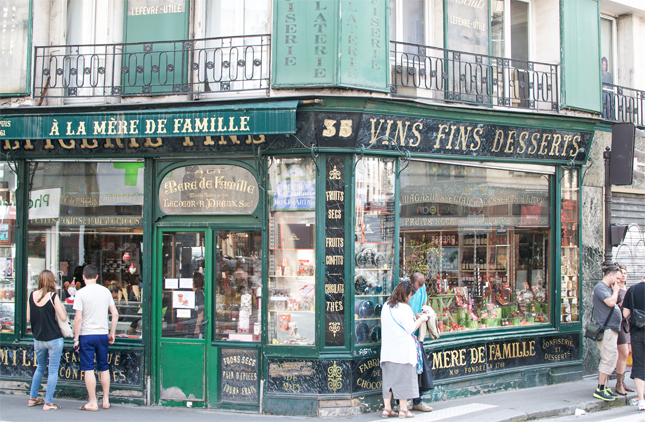
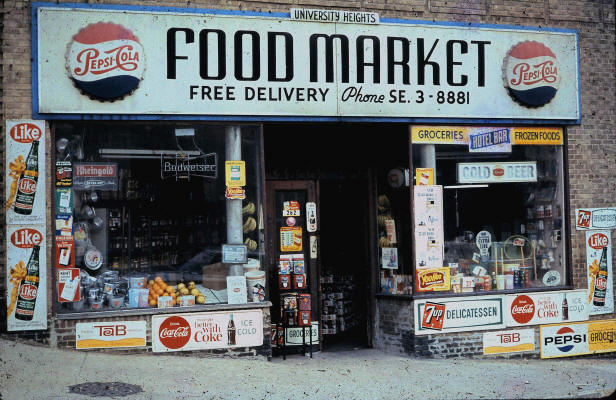
FOODSTORE

If you sit through the bitter end of a movie filmed in New York City, you’ll see that the closing credits contain a little circular logo from the New York Film Commission:  it says “Made in New York” in white letters on a blue ground.  Me, too: I am a native New Yorker from a long line of native New Yorkers, people who were truly Made in New York.

2474 Grand Avenue, Apartment 18 C, third floor, Bronx, NY 10468, halfway between Fordham Road and West 190th Street , was my family’s home.  My grandparents moved there in 1939, remaining until the mid-1970s.  It’s where I came after leaving Fitch Sanitarium where I was born early one October morning in the late 1950s. At just over 7 pounds, with black hair and indigo eyes, I was the only girl in a nursery populated with squalling baby boys. Fitch, a private hospital founded in 1849 by Dr. Charles W. Fitch, was peculiarly placed at the intersection of West 183 Street and Sedgwick Avenue at Loring Place, within walking distance of our apartment, or taxi distance, if one happened to be in labor.  I was escorted into the world by Dr. Daniel Martuccio, with the assistance of Mary Crean, an ob-gyn OR nurse who was such a good friend to my grandmother she was practically family.  To me they were always Dr. Dan and Aunt Mary.

Immediately upon meeting me that rainy midnight, Aunt Mary tied a string of beads to my wrist: black ink on white glass spelled my entire name, the same first and middle names as my grandfather’s mother, each letter closely following the other, no spacers: the unlettered beads alternated pink and blue.  I imagine Aunt Mary squinting as she poked through the wooden box containing the letter beads, her glasses perched on the tip of her nose, the same way my glasses do now, as I have long since passed the age she was on the autumn night when she strung them. Family lore says that after Dr. Dan tied the cord, Aunt Mary wrapped me in blankets like a papoose and said, “You finish up, Dan; I got what I came for” and promptly carried me into the waiting room to meet my father and grandparents.  My older sister, at home with my teenaged cousins, had to wait a few days to meet me.  Interestingly, she’s never complained about that.

I haven’t been back to 2474 Grand Avenue in years, not since the day in the early 1990’s when, on a pre-zoo detour, I saw that the entire front of the building was changed, added on to, blown out like a boil.  The addition paid no homage to the building’s original architectural classification; it was that ugly, more–room-inside-so-who-cares-about-outside style.

“That’s progress,” my husband shrugged, shifting the car into Drive, completely acquiescent of construction in a city that never stops rebuilding itself.

I scowled.  “Humph.  Desecration, more like.”

“Of what?”

“My childhood.”  What did he know?  His grandparents’ original Tudor house in Forest Hills Gardens remains unchanged to this day: no one has opened a tarot-card-reading shop where he used to play.

When I was little, 2474 Grand Avenue was big, not huge like buildings now, but normal-people big, like buildings in Greenwich Village.  It was a lot like every other building on the block in size and tenancy, which means it was nowhere near as grand as those on the Grand Concourse, but you could never have convinced me of that.  In reality, 2474 Grand Avenue probably wasn’t an especially large building, even when new in 1926, but it and its two identical siblings were distinct from their neighbors by the addition of roomy courtyards created by having the lobby situated back several feet from the sidewalk, bordered by stone balustrades and up two sets of steps: raised flowerbeds then framed the steps and paths.  On ordinary summer days, I played Barbies and jacks in there with my sister or by myself; occasionally my cousin Carl came over and Barbie’s pink world was stretched to include olive-drab GI Joe.  On days when Joe stayed home (Carl said he was “on maneuvers”), Carl and I played Go Fish or Old Maid, sitting opposite each other at the edge of a single step and using the flowerbed wall as our card table.  Neither my mom nor our grandmother had any trouble keeping an eye on us from the windows upstairs.

When it was time for a bathroom break or a drink, the lobby was reached easily through heavy glass doors decorated with black iron scrolled into a curly Italianate design.  The floor was black and white checkerboard-patterned marble and a pastoral mural was painted on the back wall. The lobby was cool and dark and had twin staircases at either side that always reminded me of our cousin Nicholas’s sticky-outty ears.  I recall ascending those stairs to 18 C many times, my little legs climbing, climbing, climbing, while clutching my mom’s hand.  At our landing, the doors stood, all alike, shiny and black.  What they lacked in individuality, however, they made up for in locks, seemingly dozens of locks, locks to be opened just in time  – or not  – when a little girl really had to potty.  On those days when I was on the inside of the door, the clinking and jangling of these locks were like Christmas bells to me, heralding the arrivals of my mom, my dad, or my grandfather.

Besides the locks, the only other really interesting thing about the front door was its proximity to the enormous coat closet.  I loved the coat closet; its dim interior smelled like the polish for my dad’s shoes and the traces of My Sin by Arpege clinging to my mom’s out-of-season wool coat. My grandfather’s red metal toolbox resided in the closet.  The heavy, glass seltzer bottles lived there, too, napping in their wooden crate, rousing themselves drowsily only on Fridays when Mr. Schmuckler, the seltzer man, took away the empties and left full ones in their places.

By city standards, the apartments in 2474 Grand were huge, with up to three bedrooms, a black and white tiled bathroom, and a living room that ran the entire width. Each living room on the street side had three large windows. The front window closest to my grandfather’s favorite chair had a wide sill, and like the old men in “Prufrock” or a solitary house cat, I hung out that window observing the opera of the street and looking for my sister, for my cousins, for my mom and dad, but mostly for my grandfather coming home from Grand Central Station, where he worked days as a Ventilation Cleaning Gang leader (essentially, a supervisor in charge of the crews who ensured the air quality in the station and its tunnels) or from the business he and my grandmother owned at 178 West Fordham Road, where he worked evenings repairing televisions and radios.  I sat on that sill a lot, playing with Colorforms plastic shapes and cutting paper dolls from old Montgomery Ward catalogs.  Sometimes I colored or connected-the-dots.  One day I accidentally knocked my sister’s souvenir Statue of Liberty out the window from that sill, breaking her torch.  (The statue’s, I mean, not my sister’s.)  Ironically, Miss Liberty currently stands on a bedside table in a guest bedroom in my own house looking perfectly content; unlike my sister, she got over it.

The kitchen in the back was narrow but not too small; we had a table and chairs in there and we all fit around the table at the same time.  The table was placed next to another big window with another big sill, wide enough for a child to lean on and unobtrusively stack peas, while hoping for pigeons or my grandfather’s parakeets to swoop down and eat the evidence.  My grandmother, who had lost her right leg from the knee down due to a childhood playground accident – an unsecured wrought-iron school gate swung into her from behind slicing her leg and damaging it irreversibly – perched on that sill, too, while she hung laundry on a line connected to our building with a pulley.  The pulley had a companion across the way, attached to someone else’s building, just outside someone else’s window.  I was surprised when my dad told me a few years ago that my grandfather had hung that clothesline; when I was little I believed that my grandmother knew the person on the other end of the rope, the person who utilized the line on days when she did not.

Walking the five or six blocks from our apartment to my grandparents’ business with my grandmother on summer mornings brought one of my life’s enduring highlights  – approaching Shields’ Bar and Grill on the corner of Grand Avenue and Fordham Road.  On summer evenings, the air around Shields’ formed its own cumulous cloud of appetizing scents like onions and hamburgers frying: raucous laughter and jukebox music spilled through its open windows, sparking my imagination.  In the clear morning air, however, it sat quietly, looking somewhat squinty and unkempt and smelling vaguely of yeast.  Nevertheless, every day on the back step rested one of the biggest pieces of ice I had ever seen; each day the block was uniformly square, about three feet by three feet, resembling an ice cube plucked from a giant’s lemonade glass. When I asked my grandfather how that was possible – our refrigerator didn’t make anything that big – he took me to the icehouse near Yankee Stadium.  Dating from the 1920’s, it made ice for the Bronx Terminal Market and other places.  I stood on the sidewalk, amazed: who’d’ve believed there really was a place that did nothing all day and all night but make enormous ice cubes?

In my imagination, huge aluminum ice cube trays, held by six burly men, were balanced under a massive tap and filled with water.  When the flow stopped, the men staggered to a big freezer and slid the trays into position, one by one. Then, when the cubes were solid, the huge handle cranked back, popping out the cubes, ready for delivery to places like Shields’.  Daily, inches from that massive block, I’d balance on tiptoe and attempt to peer into the screened back door, searching the gloom for the sources of the smells and the mystery of who exactly used that big ice cube and for what, but the dimness inside always prevented it.  My grandmother prevented it, too, tapping my right ankle with her crutch and saying, “Come on.  There’s nothing in there for you.”  Really?  I bet there was, if only I could have finagled a way to get in and find out.

My grandparents’ business was an electronics sales and repair store called DeVoe Radio & Electric (named by my dad, after the park situated just across the street), dating from the days when people still needed specialty stores and it was cheaper to repair than buy new. My grandfather fixed small appliances, like radios, and later, televisions, in the back and my grandmother ran the front of shop and kept the books.  Although DeVoe certainly wasn’t the only electronics store in New York or even in the Bronx at the time (an advertisement for the new General Electric vacuum cleaner placed in the May 19, 1949 edition of The New York Times lists dozens of them), it was one of only two on Fordham Road, and thus, well-known with a loyal clientele.  My grandfather ensured this by stocking cutting-edge products for his customers to try.  (Decades later, a waiter at Smith & Wollensky made me cry by relaying how he saw his first televised World Series baseball game playing through the front window of my grandparents’ store in 1947 when owning a television was uncommon.)

On most summer mornings I sat high up on the counter and played with the receipts poked onto a little brass pole, the receipts from in-store sales or from home repairs that my grandfather would pull from a leather folio when he returned from a call.  Sometimes I’d sit on my grandmother’s lap drawing or crafting paper clip chains (lacking the fine dexterity required to braid the more difficult chewing-gum-wrapper chains that so captivated my adolescent sister and teenaged cousins) or playing Hopscotch on the sidewalk until I felt like a melting Popsicle, and dragged myself next door to Mr. Pigola’s candy store for a cherry Coke.  This was a real cherry Coke, made with two kinds of syrup, cola and sweet cherry, tapped from soda fountain optics into a clear, ice-filled glass with the word “Coke” etched onto the side in script, and stirred with a long, twisted metal spoon.  It tasted cold and sweet and fresh.

Sometimes my grandfather invited me join him on an evening repair call. He would grab his heavy repair case and we’d be off, me trotting beside him on the wide sidewalk, clutching his free hand, and chattering.  If the location were farther than a few blocks away, we’d drive in his red Chevy Impala station wagon.  When we reached our destination, I’d follow him upstairs to the apartment; I always sat quietly where directed while he slid out chasses and changed tubes.  Occasionally someone would offer me a cookie or a glass of soda.  One elderly lady gave me a pocket-sized teddy bear to keep.

My summer days passed this way: all were virtually identical, like running those paper clip chains I made through your fingers, observing each clip’s uniformity in size and shape, with only a minor variation in color and contour.

One variation involved my mom leaving her job in Manhattan early and meeting me at the store rather than allowing me to walk home with my grandmother. I never knew when she planned to do this: hearing the shop door’s bell, I would look up and see her enter.  One such day, after re-braiding my hair and helping me pack away Barbie and Skipper, she said she and I were going for a walk.  When I asked where, she shook her head.  “Mm-mm.  It’s a surprise.”

We exited DeVoe Radio to the left, popped into the liquor store to say hello to Mr. Jacobson, waved to Mr. Applebaum as we passed his pharmacy, and continued walking along the pavement toward Sedgwick Avenue.  We stopped at the corner and didn’t cross, even when the lights changed. I waited with her, holding her cool, dry hand with my little, sweaty one and used the rubber toe of my left Keds to scratch a mosquito bite on the back of my right calf, a mosquito bite I had gotten “up the country” – my cousins’ and my name for my grandparents’ weekend house upstate.   I looked around – apartment houses, the Berenson’s grocery store, Louie Carbone’s fresh fruit and vegetable market, the butcher shop – all places my dad had worked as a teenaged delivery boy – Ralph Camera’s Gulf station, and long, long Fordham Road with the rushing highway at its base.  As the minutes passed I began to grow restless; I’d seen all this before.  Were we ever going to move?  Where were we going, anyway?  This was the wrong direction for the zoo or Aunt Fay’s house. We’d already passed the park so we weren’t going to the swings and we’d passed Piggy’s so we weren’t going to have a soda. To ride the Staten Island Ferry or see the Balto statue or the Alice clock – both in Central Park  – required traveling to Manhattan first and we were nowhere near the subway. Pretending to ignore my shifting weight and unasked questions, my mother merely gazed through her cat’s eye sunglasses at a distant point downhill.  Seconds passed.

Finally she nudged me gently and gestured with her head.  “Look. Look.”

I turned my body slightly to the right and there was my grandfather, climbing the hill from the railroad. Before my mom had even released my hand, I burst away like a dog chasing a squirrel.  My grandfather, laughing, let his Daily News fall to the pavement and caught me just before I crashed into his knees.

My mom had followed me; she bent to retrieve the paper and tuck it in her big basket purse. We walked up the hill in the fading sunshine, the three of us holding hands with me in the middle.  We stopped at Mr. Pigola’s for a packet of cherry licorice and continued along Fordham Road to meet my grandmother, just locking the front door of the store.

The workday was sighing to a close.  My dad would be home soon, and my sister.  There were groceries to buy at Daitch on the walk back to 2474 Grand Avenue, groceries that would contain the inevitable Breyer’s chocolate ice cream so beloved by my grandfather, my dad, and me. There was chicken to roast, potatoes to mash, and peas to stack on the back windowsill.  There were saltines to poke through the bars to my grandfather’s parakeets, and finally, just before bed, scoops of chocolate ice cream to eat from clear, pressed-glass bowls while watching Perry Mason, curled in my grandfather’s lap, in my grandfather’s favorite chair as the sun set behind the water towers on the city rooftops.
The Movie Star’s Shoe

shoe

New York has some pretty big rats. (I mean the ones waddling along the stone walls of the Park at night, not the ones showing up on the front page of the Post.)  When my husband took a job running a Hollywood film production facility I presumed we had left New York’s rats, pigeons, cockroaches, waterbugs, and the rest of the gritty zoologica behind; we were going to live in ocean-fresh Santa Monica with California brown pelicans and Pacific spinner dolphins just outside our door.  It never occurred to me that rats would also share our So Cal paradise until our neighbor, Debbie, told me how relieved she was that Jean Pierre, another neighbor, was having his twenty-foot tall Washingtonia filifera palms pruned.  Not understanding, I asked why.  “Ask the tree guy when he gets here” she replied knowingly.

Later that day I had a long discussion with the man pruning; he told me that rats like to live in untidy palms, the ones with the dead fronds hanging down; they enjoy the protection from the elements and the close food source that unwary humans provide.  To forestall this, the trees must be pruned twice yearly.  Chilled, I spent the rest of the day grateful for Jean Pierre’s garden diligence.

That night sitting at an outside table at The Blue Plate Oysterette, watching the sun slip behind the forty-foot King Palms lining Ocean Avenue, I idly relayed the conversation to my husband, Jamie, as he perused financial statements from the studio.  The idea so captured his imagination that for the entire time we lived there – literally, until we returned to the East Coast – every time we passed a palm tree he’d grab my arm and yell “rat!”  At first it creeped me out, but since I never saw one, eventually I concluded that there couldn’t possibly be rats in every tree. Nevertheless, those invisible rodents remained secreted inside a small, dark sliver of my mind and I cut all palm trees a wide berth .

Still rat-less, weeks later, in mid-July we were lying on our bed watching the 11 o’clock news when I heard a loud thwack. I turned to Jamie.  “Did you hear that?”

“What?”

“A smacking noise outside, like a bird hit the window.”

“So maybe a bird hit the window.”

“Jame, it’s . . . what, 11:20; what bird flies at that time of night?”

“Maybe it’s a bat.”

“Oooooh, do we have bats here?”

“Maybe it’s a rat jumping out of Jean Pierre’s palm tree.  Remember what the tree guy said.”

“Ewwwwwwwww.”

“He’s coming to get you!”  Jamie grabbed my arm.  This time I did shriek.  What if the much anticipated, palm-tree-rodent had finally arrived?  He laughed.  “If you really want to know, look out the window.”

Ours is a small house, a landmarked turn-of-the-twentieth-century beach cottage, barely ten feet away from an identical landmarked house, across the paved walkstreet that forms the center spine of the historic bungalow colony.  If that long-expected rat had appeared, he was sprawled on the porch roof, really close, maybe four feet away from the mattress.  I slid Spencer, our marmalade tabby, off my lap and faced the windows; approaching warily, I poked one finger tentatively through the blinds.

Peering through the slats, I saw that something sat in the center of the pitched porch roof; it was sleek-looking with a long slender growth from one end, too sleek-looking to be a rat, even one in overly groomed LA.   And while it was kind of rodenty in color, it appeared to have a red stomach. Was it a bloody rat?

Grabbing a long plastic back scratcher I yanked at the blind cord, then slid up the window sash and leaned out.  I poked at the object with the scratcher.  With a clunking noise, it rolled over and displayed more of its red stomach.  Feeling somewhat safer – rats don’t generally clunk and roll – I leaned out farther and tried to drag it toward me with the curled end of the scratcher.  It turned and clunked again, this time toward the edge.  Leaning out so far I feared tumbling out to join it on the small rooftop, I swatted again.  This time it caught.  I reeled it in.  It was a brown alligator Christian Louboutain stiletto.

Once I had the window closed, I sat on the rug examining my catch as it dangled expensively from the scratcher’s curved end.  It caught the light dully on its sable matte finish.  I lifted it gently and placed it beside me on the pale carpet.  It gleamed; it was a left pump, its sole smooth and crimson, not yet scratched from use.

I knew this shoe.  I had wanted a pair like this but saleswomen in every shoe department from Barney’s to Saks had sighed unctuously and inquired why I had not visited them sooner.  After all, it was the most important shoe of the collection and my size, six, was the most common in all of LA.  Covetously, I slid my bare foot inside the foundling’s cool newness.  I hobbled around to Jamie’s side of the bed.  “Look at this.”

Intrigued by the news broadcast, he ignored me.  I removed the shoe from my foot and waved it in front of his face.  “Jame, look at this.  It wasn’t a rat; it was a shoe on the roof, a brand-new Louboutain.”

He glanced up distractedly and nodded.

Perching on the edge of the mattress I twirled the shoe by its five-inch spike heel.  “How would this get here?” I mused.  “It’s expensive.  It’s alone and they come in pairs.  It’s big, too, look . . . size . . . oooh, eleven.  Wow.  And, anyway, they can’t fly, so how . . .” My voice trailed off.

Jamie looked up from the Marie Callendar commercial and jerked his head to the right. “Her,” he said.

“Her who?”

He looked at me intently and spoke slowly, punctuating his words with a pointing index finger. “Her – across the walkstreet.”  Then, just before he returned his face to the TV screen, he added, “And they can fly, by the way.”

Her Across the Walkstreet was an Oscar-winning actress known to the tabloids as America’s Sweetheart, a Chiclet-toothed girl-next-door, who earned tens of millions of dollars for every movie she made.  None of the neighbors knew her any better than the average reader of Star or People because, while she and her manager-husband owned the bungalow opposite ours, they rarely stayed there, since they also had an estate in Malibu and another in the Palisades.

After waiting for the next commercial to begin, I asked, “What are you talking about? What does she have to do with a size eleven flying Louboutain?”

“It’s her shoe.”

“How do you know?”

“Because I have met some of its relatives.”

“You can’t have; it’s here alone.”

Jamie shook his head, amazed by my naïveté.  “More distant relatives, then – a red Jimmy Choo, a black Givenchy, and . . . I am pretty sure the first one was a crème Manolo.  And they all knew how to fly, although some didn’t land too well; I thought the last one was gonna break the living room window.”

My lips formed a little “o”.  He tapped my chin and grinned.  “Close your mouth or you may catch the next one.”

It transpired that our neighbor – America’s Sweetheart – possessed the interpersonal communication skills of a thirteenth century Mongol.  Whenever she didn’t get her way she threw a screaming tantrum.  “Threw” appeared to be the operative word, too, because a shoe often accompanied the shriek; she wound back and hurled, although with less precision than enthusiasm, apparently, since no one had admitted to seeing her husband with a black eye.  And as our house sat immediately opposite theirs on the narrow walkstreet, the shoes landed most often on our porch.

I was amazed at Jamie’s story.  “When does this happen?  Where have I been?”

“I don’t know where you are.  It happens at all different times.”

“Why didn’t you tell me?”

He shrugged. “I didn’t really think about it.”

“Where are they?”

Jamie swigged his Diet Coke.  “I gave ‘em back; what do you think, I kept ‘em?”

“How?” I envisioned his knocking on the door and bowing, ‘Your shoe, madam’ like some Post-Modern Hollywood Sir Walter Raleigh.

“Usually I leave them on their front steps on my way to work in the morning.”

“Really?”

He stared.  “What else could I do with them?”

I considered.  Fill them with lemonade and freeze them, making shoe-shaped granitas. Plant them with dill and tarragon for a fashionista herb garden. Amusing, yes, but highly impractical, and nothing that my husband would have thought of.

“I don’t know.  I just . . . wondered.”

“Yeah, well, toss it down by the front door and I’ll drop it off on my way out tomorrow.”

“Okay.  I guess.”  Somehow it seemed wrong to throw it again, so I carried the shoe to the narrow staircase and descended into the inky darkness.  I wasn’t sure I wanted to return the shoe, although I certainly couldn’t formulate a reason for keeping it.  It was . . . associated glory, of sorts, like bidding on a star’s detritus at those Hollywood auctions Julien’s in Beverly Hills was always promoting.  This shoe was my own little brush with celebrity, except in this case the celebrity’s Us Magazine life had been found wanting.  Stars!  They’re just like us!  They feed their kids and phone their therapists and argue with their spouses, but their nameless neighbors have to help them find their matching shoes after they have pitched them across courtyards.

A tiny part of me wanted to feel morally superior and be sorry for America’s Sweetheart, as though my life was somehow more meaningful than hers – after all, I didn’t throw shoes – but I couldn’t quite manage that level of hypocritical envy. Regardless, for the first time I considered that beneath the great clothes and red-carpet events it must be pretty weird to be her.  She may well do all those real-people things but she does them with an aging Sober Life Coach rolling along behind her and guiding her hand while a phalanx of photographers angles to capture every misstep for posterity.

No, she is nothing like me.  I teach high school English and worry about rats in palm trees, not rats clutching cameras waiting patiently for the unflattering money shot to define me to all of America.

I sat in the darkened living room thinking until the entire colony was silent, then gently opened the door.  I tiptoed across the paving stones and lay the shoe on the doormat.    Treading softly down the wooden steps I gazed up at Jean Pierre’s palms wondering how many eyes were observing me as I completed my stealthy mission.  However many there were, it was fewer than the number that watched my neighbor park her Prius in the Whole Foods parking lot.  Maybe all the rats in LA didn’t live in the trees.

Sprechen zei Deutsch? Nein, nein.

HansFritz

When I was a kid, I thought teachers were overworked, underpaid, and got no respect from anyone, probably because I’d seen all the teacher films on Million Dollar Movie – Up the Down Staircase; To Sir, With Love; The Pride of Miss Jean Brodie; The Blackboard Jungle – and certainly none of them glorified the profession.  I certainly didn’t see myself teaching anyone anything.

But then my great-uncle Max remarried when I was twelve. The news astonished me because he had been single as long as I had known him: ex-Aunt Emily had divorced him years before I was even born and I’d had no idea he was in the market for a new wife.  It turns out that he wasn’t, at least not for just any new wife.  He wanted one in particular, a woman named Gisela, his adolescent sweetheart in Germany during the run-up to the Second World War.  They had lost each other when he fled Germany around 1938 to avoid a concentration camp and Gisela, a Catholic and in no immediate danger, remained behind.   After she and Max separated, each created a new life and married other people.  Gisela moved to a rural area in southwestern Germany while Max built his photography career in Chicago.  Eventually, both of their marriages came undone for one reason or another.  Apparently Max never forgot her and probably wondered more and more if what might have been could be still so, early in 1971, he returned to Germany to look for her, found her, married her, and brought her to America and, within a few weeks, to our house.

The visit was intended to be a mixture of business with pleasure since, in addition to seeing us, Max was due to photograph the transformers illustrating Westinghouse’s newest catalog, published by my dad’s sales support division.  That meant that he and my father would be out of the house all day.  My mother and older sister would be at work, too.  Since it was summer and I was off from school, it didn’t take long to determine that I was the one designated to stay home all day with the old German lady while everyone else scarpered off to places more interesting.  At that age, the thought of spending an entire day with any adult bored me senseless, but a foreign one who, due to the fact that she spoke no English, couldn’t even talk with me was a living death.  Besides the communication situation, there was the unwelcome threat to my autonomy.  This houseguest would keep me from doing what I loved, specifically with her in the house I couldn’t lie on my bed and read until the sun had long left its apex in the summer blue sky.

After breakfast, when Gisela went to dress, I seized the opportunity to sit alone at the kitchen table and sneak a quick read of an Agatha Christie.  I became so engrossed in the adventures of Hercule Poirot and the Clapham cook I didn’t hear her returning footsteps. At the last moment, just as Gisela re-entered the kitchen, I tried to ditch Agatha.  Because I had started too late, Gisela caught sight of the book sliding under the chair cushion.  Something about what she saw made her face open.  She pointed to Agatha, then to me, and to the book again, then to herself.  I guessed that she might be indicating that she liked to read and asking if I liked to read, too, so I nodded and said, “Yes, I love to read; it’s my favorite thing to do.”  Although she didn’t understand my words, the enthusiasm in my voice must have spoken to her because she smiled, crinkling her blue eyes, and turned to leave the room.

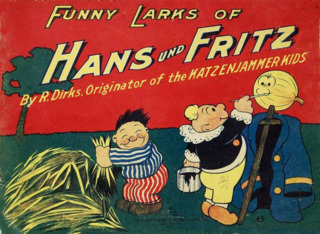
She returned less than a minute later clutching a book, a children’s reading primer withHans und Fritz printed on its cover.  She stood a few feet away and held it toward me with a hopeful expression on her face.  I had to stretch to reach the book, but I accepted it and riffled the pages.  It was simple story with pen and ink drawings of two children, telling of their adventures in clear, concise language designed to teach English to German children. I opened it to the first page. She continued to stand by a chair and nodded toward me with an expression more intensely hopeful than the last.  I cocked my head to the left like a puzzled squirrel.  What was she saying?  She tugged at the chair and began to motion next to me.  “What? Oh, okay.  Yeah, yeah, yeah, “ I answered her absently, nodding while I spoke.

I read the book aloud, slowly, and Gisela listened attentively.  Sometimes she tried to follow along in the book but at that distance it was hard for her to see the pages so I gestured for her to move closer to me.  Now that she could see more clearly, she followed along even more intently.  Sometimes she reached out to run her index finger across the page under the words as she tried to determine which part of the text I was reading.  Her brow furrowed slightly as she whispered the words I spoke after I read them aloud.  She appeared so engaged in mastering the words that I felt bad that it was such a short book and I started over.  Then I started again. Sometimes she gazed at me as I read the words aloud and once or twice she turned my face toward hers by very gently placing her soft, cool fingers on my jaw or my lips so she could feel the shape of my face as I created the sounds.  Startled and, at first, puzzled by the gesture, finally I figured out what she was doing – she was trying to understand how to form the strange-sounding English words that seemed to possess the same meaning as the more guttural language she already knew.

Ultimately I was able to discern which chubby boy was Hans and which was Fritz and, flattered by her obvious appreciation of my reading skill, I began to alter my voice for each character.  Then I pointed at them when the drawing indicated actions, like jumping rope, shooting marbles, slipping down a slide, or eating a meal so she could learn the verb in English representing the action she surely recognized. Eventually, I must have read the whole book through ten or twelve times.

The hours passed and my family returned home.  Immediately upon entering the house, Max walked over to embrace Gisela and he asked her in German what she’d done all day.  She smiled, and then she picked up Hans und Fritz and read the entire book aloud with mostly correct pronunciation.  I remember the amazement on Max’s face as he heard her speaking English, a little haltingly, but still speaking it, and she beamed when he hugged her.   When he asked her how she had learned to do that in one day, she reached across the table and clasped the back of my wrist.

This point is where a lesser woman would announce that this moment of interpersonal warmth and educational triumph inspired her career choice by having allowed her to discover that she was a born teacher.  Alas, life is not like the movies and I am not Sandy Dennis.

Here is also where a lesser woman would claim that this day’s triumph was just the beginning for Gisela, that she became a fluent English speaker.  That isn’t true, either.  When I visited Max and Gisela in Southern California four years later she still couldn’t speak a word of English, although she could read Hans und Fritz aloud from cover to cover, so I guess I taught her something.

Regardless, Gisela taught me something, although I wasn’t aware of it until decades later when I missed a train in Paris: she taught me that you can actually spend an entire day – rather pleasantly – communicating with someone you cannot talk to.  If only every day of my life were so fruitful.

Why I Love Manhattan

Laura Driving

Native New Yorkers view the world through the grimy lens of cynicism.  Expecting and preparing for the worst possible result from all people and situations seems to us the most sensible way to travel through this life.  And travel we do – on buses, in taxis, on ferries, and through subway tunnels, all within close proximity to our fellow citizens.  Because of these myriad public transportation options, most of us don’t have a personal relationship with the internal combustion engine; after all, if God had intended for New Yorkers to drive, He wouldn’t have provided Alfred Ely Beach the idea for an underground pneumatic railroad back in 1869.

And the subway works just fine, thank you.  More or less, anyway.  Okay, it’s sweltering in the summer, stifling in the winter, and crowded all the time, but, it’s so much easier than taxis or buses.  Relatively few things can go wrong.  It runs on tracks from point A to point B; it can be fast or slow or stuck in a tunnel, but it will never deviate from its path leaving you stranded in a strange neighborhood.  And for those occasions requiring personal transportation there’s an Avis Car Rental garage on East 43rd Street.

My grandfather owned a car in the city which he used for both his business and to drive upstate for weekends; my father had one, too.  Although I had learned to drive, I rarely saw the need to actually do so.  I had always commuted to school and work in the more traditional fashion – strolling to the subway stop, passing the firehouse, chatting with the firemen and petting the dog, picking up a newspaper and coffee, and observing the theatre of the city’s streets along the way.

Like most New Yorkers, I’ve seen pretty much everything life has to offer on those walks – from the homeless man lying on a dirty plaid sofa watching tv under the Queensboro Bridge to the bride in full white wedding regalia boarding the B train. I’ve seen it with my own eyes, I’ve seen it often, and right now it’s blocking the entrance to the building where I need to go, dammit.  And no one in New York has seen more than its police officers.

In the early years of our relationship, my husband Jamie’s office was in Brooklyn Heights and we lived on the Upper West Side, just a few blocks from Engine Company 76.  Jamie’s was an inconvenient and time-consuming commute so Louis, his boss, thought a company car was in order: that’s how a blue Mercedes C class entered our family immediately enroll ing us in that subset of city dwellers whose lives are governed by the New York City Department of Transportation Alternate Side Parking calendar, downloadable in various languages including Chinese, Russian, and Haitian Creole.  (Believe me; woe of apocalyptic proportions betides the ignorant fool who leaves his car on the wrong side of the street when a Department of Sanitation street sweeper is due.)  Months passed with Jamie driving to work and my hopping on the train, each of us pleased with the arrangement. Then came the summer Saturday that we were invited to dinner with friends in Chappaqua, out of the city, one of those occasions that the car was supposed to make easier.

Around noon, Jamie wandered into the living room where I was watching a film I’d recorded.  I pushed the pause button  when he began to talk. “I have to go to meet Stu at Hudson Street at 3 o’clock so why don’t we get ready early, I’ll go to the meeting then call you when we’re through and you can meet me and we’ll head to the Damiano’s.”

I considered the suggestion, then shrugged, unimpressed with the idea. “What’ll I do while you’re with Stu?”

“Go shopping in SoHo.”

I wrinkled my nose. “No, I don’t want to do that. It’s a schlep from Hudson to any stores I like and I was going to wear the blue suit with high heels tonight and I hate walking around outside in nice shoes.”

“Take the car.”

“Yeah, and park at Hudson Street and I’ll still have to walk all the way over to West Broadway.  No, thanks.”

“No, you take the car, park on Broadway and I’ll walk over and meet you when Stu and I’re done.”

Pause.  “Me drive?”

“Yeah, you know how.”

Exhale.  “Yeah, I know I know how but I don’t parallel park real well.”

“So learn.”

He was using that tone, that ‘What’s wrong? Can’t rise to the challenge?’ tone that I hate but remain unable to resist.

Two beats, then three.  I blinked.  He blinked.  I sighed.  “Okay, fine.  I guess I’d better get in the shower now then.”

By 2:45 pm we were downtown.  Jamie exited the car in front of his friend’s mid-block office building and I slid behind the wheel.  Before slamming the door he leaned in and said, “I’ll call you when I’m through and you can tell me where you are and I’ll come find you.  Then we’ll drive to the Damiano’s.”

“Humph, I’ll probably be in traffic court.”

“Nope, you never get a court date the same day as the offense.” Grinning, he slammed the door and strolled away.

Using my walker’s geography I tried to figure out how to pilot this monstrous vehicle back toward Broadway.  I knew that avenues run north to south and streets are east to west but I am an Upper West Side baby; except for attending NYU, I had little experience with southern Manhattan and even for that I exited the subway at West Fourth Street and walked.  I knew that Hudson Street met West Broadway somewhere around Chambers Street and that it runs both north and south so I could find the stores I wanted easily enough, providing I could get to that point.  The problem was that all of this was in the direction opposite of where I was headed and I didn’t have the vaguest idea how to get back to where I wanted to be.

Guided only by rudimentary New Yorker’s geography – east are the beaches of Long Island and west is New Jersey and everywhere else until you reach Los Angeles – I nosed into the thick Saturday afternoon traffic, slowly, nervously, inching what I hoped was eastward.  So many people, so many cars, so many trucks, so many One Way signs sprang before me that in no time I was completely discombobulated.  I don’t know what I did wrong but  I found myself crushed in the middle of the New Jersey-bound Canal Street traffic jam crawling toward the open, leering mouth of the Holland Tunnel.  Damn Jamie and his bright ideas.

Even the thought  of the tunnel panicked me.  Obviously it began in lower Manhattan but I had no idea where it ended.  My mind conjured images of Lucy Ricardo’s first driving lesson when, panicked, she attempted a three-point turn in the tunnel and reportedly stopped traffic all the way to East Orange, New Jersey.  Determined not to befall the same fate, I looked nervously for someplace, anyplace, to turn out of the stream.  It wasn’t going to be easy; all of the streets seemed to be one way, feeding into the four lane bottleneck approach to the double-tube tunnel. My palms grew sweatier with each street I passed.  About a block before the actual entrance I noticed another one-way sign pointing toward Canal Street but the street itself was blocked by blue NYPD sawhorses.  Rejoicing, I switched on my right turn signal and began the laborious process of exiting to the right.  I swerved around the sawhorse and saw three New York City police officers standing by identical sawhorses at the opposite end of the street; they were waving away all traffic attempting to turn into the street.  Hearing my approaching engine, one broke from the cluster and sauntered toward my car.  He gestured for me to stop, so I did; I lowered the window and waited expectantly, hopefully.

“Lady, did you see the one-way sign?”

“Yes, but I’m lost.  I was getting forced into the tunnel traffic and I didn’t mean to go there. I don’t want to go into the tunnel.  I don’t even know where it goes.  I was trying to get over to the left to go to West Broadway but nobody would let me over.  So I turned here to go around the block and try another way.” I smiled.

His eyes narrowed slightly.  “Lady, this is a one-way street. You’re going the wrong way.”

“Yes, I know.” Hadn’t I just explained that?

He flexed his jaw.  “You’re going the wrong way on a one-way street. You have to turn around and go back”

“No, I can’t go that way. I’ll get pushed into the tunnel.” My hope was fading.

“Look, lady, either you turn around or I am going to write you a ticket for driving the wrong way on a one-way street. Now turn around.”

“No, I’ll get pushed into the tunnel.  If you have to write the ticket, then write it but  I can’t go back that way. Nobody will let me over and I’ll end up somewhere in New Jersey, I don’t even know where.” At this point all hope was gone and panic was creeping into my voice, not for the ticket, but for the possibility of getting lost in New Jersey.

He pushed his cap further back on his head as he stared at me staring at him.  He sighed. “Lady, what do you want me to do, stop the traffic for you?”

“Yes, please.”

His eyes widened.  My choosing to take his sarcasm seriously meant he was now stuck, as stuck as I was.  He sighed again.  “All right.  Turn around and follow me.”

I executed my three-point turn successfully and followed him up the sight grade.  He stepped into the first lane of traffic and held up his right palm toward it while gesturing for me to follow with his left.  He repeated the process through the lanes until all approaching cars had stopped; I followed behind him an inch at a time like a tentative but obedient dog.   After I had cut diagonally across the stopped  traffic I braked near the officer.  He lifted his left arm and pointed theatrically in the direction I needed to go, then swept his right arm across his chest, brushing past his face, then dropped his head in a dramatic courtier’s bow.  I yelled ‘thank you’ through the closed window and accelerated slightly.  As I passed him I could see the grin on his face.

Yes, we’ve seen it all here in New York.  And there are reasons why many of us choose not to drive.