
Regrets? I’ve Had a Few

th

When I was about twenty-three, I got a part-time holiday job as a salesclerk at Bloomingdale’s. I chose Bloomie’s because it was located near my daytime job and I hoped that I could convince the credit office to just apply my salary directly to my charge bill, but evidently that wasn’t the way it worked.

Regardless, I completed training, received my gold B and reported to work on a Saturday afternoon. I had been assigned to men’s underwear, which was then located on the Third Avenue side of the first floor. Despite knowing nothing about the product, I wasn’t unhappy with this assignment – I was young, slim, blonde, pretty, and single and I expected to get a few dates out of this. Even if I had been reluctant to work there, it wouldn’t have mattered; I was part of what was called the Flying Squad and, like a missionary, had to go where I was sent.

I rode down from Personnel in the employee elevator and trotted into the men’s furnishings department wondering whom I might meet. I found the manager and asked him where I should stand; he asked me to straighten the Calvin Klein briefs and assist anyone who required help. I could handle that.

I began to reorganize the – for that time period – expensive designer undergarments by size, color, and style. It wasn’t easy. Customers all but ripped them from my hands while searching for a particular style or color and demanded that I check the stock room for anything not immediately visible. I wouldn’t have minded if the customers had been handsome, young men, but they were all women, all afternoon, a six-hour shift full of cranky women. Evidently men don’t furnish themselves in New York City.

By the time six pm came I was exhausted and growing a little cranky myself. Even though the store was open late for the pre-Christmas rush, the crowds had thinned, as the shopping-bag-clutching hoards exited through the Fifty-Ninth Street door for theatres and restaurants.

I leaned against a glass counter and surveyed. The entire department looked as if a bomb had been detonated in the middle of it. Catching sight of my reflection in a mirrored pillar, I noticed that I didn’t look too good either; my clothes were rumpled, my hair was sagging, and I had dark rings under my eyes like a baby panda. Sighing, I began to collect the discarded black and white cardboard packages to replace and re-order them one final time.

“Nice Christmas decorations this year,” said a quiet male voice behind me.

On my knees on the carpet, stuffing extra stock into a drawer, I hadn’t heard him approach. Startled, I leaped up and wobbled on my ill-chosen spike heels. He caught my elbow and peering into my face, asked, “Are you all right?”

Embarrassed, I pushed my hair back and mumbled, “Yeah, I’m fine, thank you.” I hadn’t even looked at the man who had broken my fall.

“Are you sure? You look frazzled.” He responded in a voice that was beginning to sound familiar.

“Really, I’m fine, thank you; it’s just been a long day.” I looked up at my rescuer – straight into the velvet brown eyes of Al Pacino. I blinked. Michael Corleone. Bobby Deerfield. Serpico. The bank robber from Dog Day Afternoon. I nearly passed out.

He smiled. “What time do you get off? Do you want to get a cup of coffee?”

What? Al Pacino was asking me out? I panicked, turned bright crimson, and mumbled, “I . . . I . . . I can’t.”

At that moment, I heard the manager call my name. My head snapped in his direction and as I spun on my skinny heel, I realized that Mr. Pacino was still cradling my left elbow. “I . . . I need that,” I squeaked. Pulling my arm away, I fled into the stockroom.

I hid in there organizing underpants for the next hour until my friend Kim wandered in. “Hey, come on, we’re done. Let’s go. Here, I brought your coat.”

Unspeaking, I shoved my arms into the camel sleeves and strode toward the employee elevator. “Hey, wait for me!” Kim shouted behind me.

I didn’t speak all the way to the employee entrance or after we punched out and began dodging tourists on Sixtieth Street. Finally, as we stood on the corner of Madison Avenue, Kim tugged at my arm. “What is wrong with you?”

I didn’t answer. Kim’s eyes grew wider. “Oh, I know, you made a mistake with the register, didn’t you?”

I shook my head and began to cross with the Walk signal. Kim trotted after me. “Well, what went wrong, then?”

I stopped on the uptown west corner of the Avenue and faced her. I chewed my lip. “Al Pacino came into the department.”

Her eyes widened. “The Godfather? Dog Day Afternoon?”

I nodded.

“Well?” she prodded. “Did you say something stupid to him?”

I nodded again.

“Oh, God, what did you say? Did you say you’re his biggest fan?” she taunted.

I shook my head. “No. Stupider than that.”

“Well, what?”

“He asked me out and I said no.”

“WHAT?”

“You heard me.”

“Al Pacino asked you out and you said no?” Her voice was so loud that passing tourists were beginning to stare at us.

“Yes, I said no.”

Kim shook her head slowly, as though there was no hope for someone like me. “You really are an idiot,” she said sadly.

Looking back on that night, all these years later, Kim was right; I was an idiot. I don’t know why I said no. I panicked. Maybe if I had said yes, my life would be completely different than it is. But I doubt it. He asked me for coffee, not to marry him, and probably my life would have turned out the same. But I have learned that opportunities don’t pop up unbidden every day and it’s far better to grab them and squeeze the life out of them than it is to fear them and wonder what might have been.

And Here’s to You, Mrs. Malaprop

th

Of all the writing mistakes people make, the malapropisms are my favorites. Defined loosely as “a comically inappropriate word or phrase,” the word derives from the French phrase ‘mal a propos’ and was lifted by Richard Sheridan for a character in his Restoration comedy, The Rivals. From British sitcom character Mrs. Slocum in Are You Being Served (“and I am unanimous about this”) through 1960’s nightclub comic Norm Crosby (“the misconstrued youths of America need heroes”) to 1970’s television antihero Archie Bunker (“Aw, Edith no one wants to hear about your visit to the groinocologist”), I have always loved characters who speak in malapropisms, which is good because Facebook comments sections have exposed that an enormous segment of the English speaking public does so.

Sometimes the malapropisms are the best things in the comment; certainly they are the wittiest and the most original. Many times they’re so funny I find myself bursting into laughter at a person I have never met.  A good malaprop always brightens my day, although, to be honest, many people’s writing more often contains mondegreens than malapropisms. (A mondegreen is a sort of aural malaprop that occurs when people mishear something – an aphorism or song lyrics – like the people who wonder about the homoeroticism of Jimi Hendrix because they think “’Scuse me while I kiss this guy” is a lyric in one of his most famous compositions.)

One of my favorite mondegreens came from a Goodreads book discussion a few years ago. To accompany the reading of The Namesake by Jhumpa Lahiri, the group appeared to be sharing their personal experiences with family interactions and generational clashes, prominent themes in the book. Several expressed sympathy for one character or another, based seemingly on exactly what about their own family’s dynamic upset them personally. Decrying her birth order, one youngest daughter of a large family wrote that she could understand Ashima’s reluctance to shop at garage sales because “I’m really tired of wearing my sister’s hammydowns.”

Hammydowns? Suddenly I had a vision of Lady Gaga’s meat dress, only made of delicate pink ham slices dotted with spicy, black, button-like cloves. For years this girl has apparently thought that the word for clothing passed from one child to another in a family is “hammydowns.” I bet that she’s heard it pronounced that way her entire life, but has never seen the phrase “hand-me-down” in print and wondered about its etymology. She trusts that her friends know what she means, regardless of how she says what she says.

When you consider this profound lack of attentiveness as the true source of the amusing errors, the situation leaps from comedy to tragedy.

It’s the profound lack of concern, the dearth of intellectual contemplation that really troubles me about my fellow citizens’ rhetoric. They don’t care if their writing contains careless errors. By this I don’t mean typos that all of us must proofread for or even fractured syntax as we stumble to find the perfect phrase to say what we think. No, I mean the total resistance to the mechanics of academics – the refusal to read closely and analyze, then write about, complex ideas.  Even worse, when someone corrects the errors, the original poster’s response is blind fury; accusations of “Who made you the grammar police?” and “You knew what I meant, so who cares?” fly across the screen. Everyone can apparently say whatever he or she wants, regardless of how illiterate, illogical, or poorly-written. Welcome to Post Modern life where just folks spit out thoughts in chunks – it’s the Murcan way, evidently – and only elitist, East Coast academics attempt to write with clarity.

Today I read that a New England Patriots player misspelled the team’s name on a pair of jeans he “designed.” Evidently, neither he nor the seamstress who embroidered the word noticed the error. That’s okay. We all knew what he meant. And when he’s done wearing the jeans, they’ll make a nice hammydown for his kids.


I Dreamed I Married Paul Drake

drake

I dreamed I married Paul Drake. Yes, Paul Drake, the dashing, blonde, poker-playing, convertible-driving, well-dressed, wisecracking, private eye from Perry Mason and we lived in a high-rise in noirish, 1950’s Los Angeles. We met after I hired him although what precise problem I wanted the Drake Detective Agency to solve for me disappeared immediately upon the ringing of the 5:45 am alarm. I only remember the feeling that the dream gave me, one of taking part in my own period murder mystery in a black and white world with myriad shades of gray in between, where nothing was as it seemed but everything certainly seemed better than it did after I awoke.

It is said that the soul of the City of Angels has been fought over by representatives of both the dark alleys and the sunshine-filled beaches as far back as the heyday of gangster Mickey Cohen and crusading police officer Bill Parker, but nineteen fifties Los Angeles was an interesting place for reasons other than the moral dichotomy personified by its nationally-known protagonists.

While mid-century LA was no longer the hardboiled city of Raymond Chandler heroes, it had forged a new identity, as the final destination for happiness, the Golden West of many people’s dreams.  When literary characters from the Joads to Sal Paradise climbed into their cars, their destination was California; movies and television followed suit, so it wasn’t long before real people did, too, creating a migration of ex-servicemen and their families seeking jobs in the emerging aerospace industry and the healthy, outdoor lifestyle.

Nineteen fifties California seems so much better than its twenty-first century sibling.  Certainly it was far less crowded than it is now; neighborhoods were smaller in scale, filled with single-family homes rather than the ugly, low-slung, stucco apartment buildings that replaced them. Half of Malibu could have been purchased for the cost of one current oceanfront villa.   Cars were fewer and were the size of small boats while orange groves still covered much of the land.

Life was more orderly and far more stylish.   Women wore pencil skirts from Bullock’s Wilshire and ate at chophouses like Musso and Frank’s.   Middle-class families went for burgers at Tommy’s then to a movie at the Gilmore Drive-In near the Farmers’ Market in Fairfax then drove home to their subdivisions on nearly empty freeways while the lower-classes still rode Angel’s Flight to the top of Bunker Hill.

Time moved more slowly, probably because there was no Internet or 24 hour news cycles, so things took as long as they took, and no one felt the compulsion to create events for public consumption.   The personal touch mattered; when a customer contacted a business, a person answered the telephone or responded to the letter.   With no cell phones or Facebook, people were not in constant communication with one another, making their attention spans longer.  Commercials on television shows were shorter.  My parents new hi-fidelity record player revolutionized the sound of my father’s opera recordings.  The coolest technological thing I remember seeing was the telephone in Paul Drake’s Thunderbird which he could use only after the mobile operator came on the line and connected him to Perry or Della.

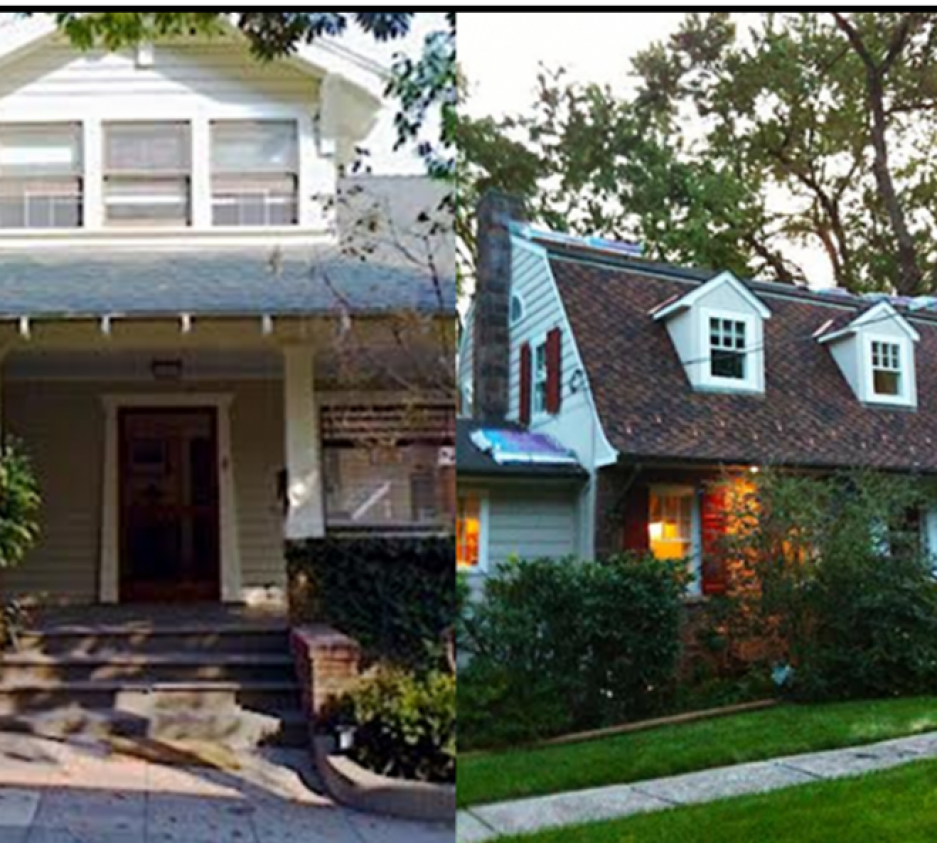
I realize that I sound like a Luddite but I have always looked backward for beauty and inspiration. Our houses are from the ‘twenties and are furnished with family heirlooms. My favorite styles of clothing date from the nineteen forties. I watch old murder mysteries and dramas on TCM. I refuse to have plastic containers in my kitchen, preferring the Corning glass and Pyrex of my grandmother’s time. Even my favorite authors have been dead for decades. Oh, I haven’t completely abandoned my own generation’s toys and tools: our life has Kindles and iPads and iPhones. We stream movies and text one another when we are delayed on the now-crowded freeways. But I think I dreamed I married Paul Drake not only because William Hopper, the actor playing him, was so handsome – even though he was – or just because I long to be the protagonist of my own drama – although I probably do – but because I value fewer and simpler things.  I find them only in my dreams.

You Know Where the Bus Stop Is.

th

I grew up in a simpler time; despite living in New York City, it was a time of childhood adventure and freedom, that golden age before the disappearance of Etan Patz. Oh, sure, Times Square was seedy and Needle Park marred the Upper West Side but overall, the city was quite safe; my sister and I could play hopscotch on the sidewalk unmolested and walk to the park or Alexander’s without drawing unwanted attention from anyone. Not only could we go places alone, my parents – particularly my mother – encouraged it. We lived in a city, a great city full of artistic and musical resources, and she expected us to use it.

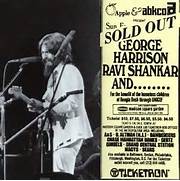
When I was twelve, George Harrison’s Concert for Bangladesh rolled into Madison Square Garden. It was an all-star lineup – the first I had ever seen – joining to raise money for a cause, in this case to counteract the effects of a famine in a country I doubt I could have found on a map then: it was truly ahead of its time, the precursor for No Nukes, Live Aid, Farm Aid, and countless others. I had heard about the show from Pete Fornatale, Scott Muni, and the other deejays on powerhouse WNEW-FM, arguably the most influential of AOR stations. It didn’t matter what it was for, anyway; the lineup boasted George Harrison, Eric Clapton, Billy Preston, Bob Dylan, and- my favorite – Leon Russell, among others and my best friend, Kim Brennan, and I wanted to go. The Garden was a bus ride downtown and a world away and all I needed was parental permission.

The two shows were scheduled for August 1, 1971, at 2:30 and 8 PM. Tickets were only about $8 and had gone on sale in July. Deciding that the afternoon show was more likely to elicit parental approval than the 8 pm one, Kim and I stood in line at the crowded box office. According to the sign, tickets were limited to four per buyer, so Kim and I decided to purchase that number, just in case an older sibling or two were sent along with us as chaperones. By the time we reached the front of the line, however, demand had caused the limit to change and each buyer was permitted only two. At this we grew frantic (it had not occurred to us that, as two people, we could still buy four) and we wondered how we could be certain our parents would permit us to attend unaccompanied. We handed over our crumpled singles and quarters and pocketed the tickets, the thrill of possession only slightly dampened by the cold realization that we might not be able to go.

As the ensuing weeks passed, Kim and I attempted to come up with a foolproof argument for why our parents should allow two middle-schoolers to attend a smoky, druggy, rock concert alone. ‘Everybody was going’ never worked with my parents, although it tended to persuade hers, probably because they were a few years younger than mine. The fact that it was for charity might sway my mom, although my dad was more likely to offer to write a check and tell me to go watch Million Dollar Movie and do my homework. As the day grew nearer and neither of us broached the subject with either set of parents, the situation began to seem hopeless. We feared they wouldn’t let us go see the show and we’d be out all of our pocket money and have missed seeing Eric Clapton and Leon Russell.

I thought I would sound out my mother the Saturday before the show as I helped her make dinner but she was preoccupied and grumpy over something stupid that my older sister had done, although her specific transgression is long lost into the mists of time. Whatever it was had infuriated my parents, though, prompting my father to go to his office that afternoon and my mom to spend the day in the kitchen slamming things. Dinner was silent and tense with my parents steaming and my sister sulking.

“Well, this is great,” I thought as I scrubbed the pots alone after dinner, my sister having repaired to her room with as much dignity as she could muster. “They are already furious about one kid. I can just hear it when I announce that I already bought the ticket.”

When I had finished in the kitchen I lifted the kitchen receiver gently and dialed Kim’s number. “Did you ask yet?” I whispered.

“No,” she hissed back. “Now isn’t a good time. My idiot little brother got caught shoplifting a Matchbox car at Woolworth’s and they are furious.”

Amazed at the universal stupidity of siblings, I sighed, “Yeah, here, too, only it’s my sister and it’s not a Matchbox car. Whatever it is is so bad they aren’t even saying.”

Kim sighed, too. “Well, tomorrow morning is our last chance,” she observed hanging up.

I was so depressed I went to bed at 8 pm with an Agatha Christie, cursing my luck, my sister, Kim’s brother, and my impending financial and artistic poverty.

Sunday morning I rose early, and, unasked, set the table for breakfast and cleaned up afterward. I dressed nicely for Sunday School and church and was ready early. Nobody noticed, though; both parents were angry about and preoccupied with my sister’s transgression. Just as we were about to leave for Fifth Avenue Presbyterian, I turned to my mom.

Taking a deep breath I blurted, “Can I go see the Concert for Bangladesh at Madison Square Garden today?”

My mother looked up from shoving Kleenex into her handbag. “With who?”

“Kim Brennan.”

She shrugged and returned to her task. “You know where the bus stop is.”

My father looked up from where he had been wiping the toes of his brogues with his handkerchief, a habit that made my mom furious.   “Wait a minute. You think she’s old enough to go to the Garden on her own?”

My mother’s brown eyes bored into my father’s blue ones. “She won’t be alone; she is going with Kim. And I seem to have raised one child who can’t look after herself; I’ll be damned if I raise another one.”

They stared at one another for a minute then my father said, “At least call Kim’s parents and make sure it’s all right with them.”

My mom did. We went to church. Soon after we arrived home Kim’s dad dropped her at our house. My mom walked us to the bus stop and waited until the bus arrived.

“You have your tickets?” she asked as it pulled toward us and sighed to a stop.

“Yes,” we answered in unison, holding them aloft, crushed and sweaty.

“You know which bus to take home?”

“Yes.” We both nodded.

“You have money to call if anything goes wrong?”

“Yes.” We continued bobbing our heads affirmatively.

“Okay, have fun.”

The bus driver closed the door and off we went to one of the most amazing experiences of my young life. The show was great. Afterward, we called Kim’s dad from a pay phone booth and told him that we were going to the bus stop for the ride home, which we did. No one bothered us; no one even spoke to us.  Kim’s dad was waiting at our corner when we exited the bus.

Years later, I met Eric Clapton at the Chelsea Arts Club in London and told him the story. He roared with laughter. “You had pretty progressive parents.” Now, as an adult, looking back on that day, I realized that he was right; I did. And at least as cool as the concert was – and it was a cool concert – is the thought that our parents trusted us, trusted the other concertgoers, and trusted New York. That is priceless.

The Longer I Live, the Less I Understand

thCollege admissions have changed a lot since I was an undergraduate. I was reminded of this recently as I applied for a place in a rigorous summer program to study John Steinbeck at a prestigious California university.

When I was applying to colleges as a high school student, everything was done by pen and paper and the U. S. mail.   You telephoned university admissions offices after school to ask for bulky catalogs because most high school guidance offices expected you to know what you wanted before you told them where they should mail the copies of your official transcripts. A few counselors may have suggested places you might like to consider based on your grades and career aspirations – if you asked – but Mrs. Gardner certainly never presented me with a spreadsheet of universities I should apply to, color-coded by such designations as “safety school” and “reach school.”

The methods by which you achieved admission to colleges were within your control, as well. Classes were generally tracked into two or three levels; no one signed up for every AP class. (There weren’t many to enroll in, anyway, since the AP program only began to flower in the mid-1970’s.) You earned your best grades in the classes you were in and took your chances.

Sitting for the SAT was of paramount importance and had been since the College Board was founded in the late nineteenth century to create a standardized method of testing that depended on “scholastic aptitude” (the test’s original name) rather than the diverse and seemingly random entrance exams given by universities to prospective students. You brought a check from your mom to the guidance secretary and signed your name on the sheet of notebook paper Scotch-taped to the counselor’s door if you planned to take either the PSAT or SAT when it was next scheduled in your area, invariably early on a Saturday morning. If you scored poorly, you could take a Kaplan preparatory course for about $100 or just practice on your own until the next sitting rolled around, usually in about two months. There was also no ACT to sit for if you found the SAT too hard. (The ACT was developed in 1959 as an admissions tool for public or regional schools, as it was believed that only the especially selective East Coast colleges relied primarily on the SAT at that time; until 2007, when the ACT was accepted by every four-year college in the country, it was seen as the lesser test.)

Then, on a crisp, fall, Saturday morning, you spread all of your documents across the dining room table and, Bic blue or black ballpoint in hand, began filling in the little boxes with the letters and numbers of your full name, birth date, social security number, and proposed major. You took the tidy Xeroxed copies of your typewritten or handwritten personal statement (if requested – not all colleges asked for one because the pool of applicants was statistically smaller; only 32% of graduating high school seniors took the SAT in 1975, so far fewer students applied to universities than do so now) and added them to the small but growing stacks.

Your parents sat down next to you with their tax returns and began a filling-in process of their own of the financial aid forms. They wrote checks for application fees. You stuffed envelopes and licked stamps. They drove you to the post office where you stood in line to mail your sleek, legal-sized, brown packets of qualifications to the bastions of higher education that you knew were going to help you achieve the future you expected and deserved. You had rolled the academic dice; now it was up to the mysterious Admissions people and the peculiar alchemy of whomever else also applied that year.

Then you waited. And waited.

When Acceptance Day came you didn’t even need to open the envelope peeking out from behind the electric bill in the mailbox; you knew from the size. Fat envelope meant you’re in and skinny one meant you’re not. It was an easy system for the faint of heart.

And this is how we did it even through my applying to New York University for a Master’s program in the early 1990’s. Fat envelope v. skinny envelope. Your fate was sealed and if it was skinny, sometimes it remained sealed and went straight into the trash bin.

The entire process had changed by the time I applied to graduate school at Columbia University in the early 2000’s. I completed application forms on Internet PDFs, paid fees by credit card, and requested transcripts via online University portals. I was accepted by email.  It wasn’t the same.

The anticipation of receiving a letter, the excitement of seeing the fat envelope adorned with the university’s seal that you knew was stuffed with congratulatory form letters, mimeographed maps of the campus, and requests for campus housing is not equaled by a single line email: “Congratulations! You have been accepted into the (year) class of (name) University.” I understand that the sheer volume of application documentation has caused the process to adapt but it doesn’t alter my opinion. The process has become soulless and empty. The magic is gone.

For the California program, I typed a resume and an essay in my laptop, saved them in digital file folders, and submitted both as email attachments. I completed and emailed application PDFs. I printed online forms requiring a handwritten signature, signed and then photographed them with an IPhone app to make new PDFs of the finished document.   And, certain that technology would fail me, I retained hard copies of everything. Not a single stamp was pasted nor envelope sealed, yet interestingly enough, the process was just as tedious as the old days and a heck of a lot less gratifying.

Perhaps knowing this, the director of the California program graciously telephoned her acceptance of me. It was a lovely throwback to a different era. I appreciated it.

Some Really Do Like it Hot

hot4

I have loved 1930’s, ‘40’s, and ‘50’s movies since childhood, probably because my mom likes them. When she was young, she had been employed as a film censor at the local offices of both MGM and Warner Brothers where she watched all of the movies on a Movieola, removing exactly – and only – the relevant frames, leaving the rest of the film intact.. (Film censors cut objectionable scenes from nationally released movies so that they conformed to the obscenity laws in each locality.) She told me about her favorites, so when they appeared on Million Dollar Movie or late night television, we watched them together: sometimes when they were shown uncut in art house cinemas, we would travel downtown and view them on big screens – the way they were meant to be seen – which was always much better than our little tv.

Jamie likes movies but doesn’t love them as I do, so while he is willing to watch classic films, especially the black and white ones, they don’t speak to him as they do to me. Nevertheless, we have an iTunes library stuffed with them and watch them through every platform imaginable. We load both iPads with them so when we travel to Italy in August we have something enjoyable to watch late at night after the walk into town for dinner, gelato, and una passeggiata. Correction: I have something enjoyable to watch late at night and before falling asleep; Jamie has always been downstairs in the garden, where the cell reception was better, pacing and talking on the phone to the studio.

I watched all of my favorites – Some Like It Hot, Clash by Night, Dark Passage, Charge of the Light Brigade, They Drive by Night, any and all releases by Hitchcock, Wilder, MGM, or Warner Brothers – then fell asleep by the time Jamie reentered the room. The next morning, we’d awaken and trot down the stairs to breakfast and I knew that the time difference between Forte dei Marmi and Culver City left us free from the ringing phone for a few hours.

His phone rang unexpectedly one afternoon. Checking the screen, he answered, then slipped on his Docksiders to wander over to the boardwalk where he could pace and talk. He returned in a few minutes frowning.

“What happened?” I asked, looking up from my book as he sat on his lounge.

“There’s a meeting in New York that I have to attend,” he answered beginning a search on his iPad.

“When?” I asked.

“Tomorrow,” he answered.

“Tomorrow?” I squeaked.

“Yep. I’ll explain in a minute. Let me make reservations.”

I was annoyed. Jamie’s work life overshadowed our home life so tremendously already that I was furious at the money guys in New York for deciding that a conference call was unacceptable and Jamie’s physical presence was required. We were in Italy for crying out loud; to fly back from Italy to New York for a meeting struck me as total insanity, even if it was on the company’s dime. Besides, Jamie took only two weeks vacation as it was – despite being entitled to at least four weeks more – because the studio business was so all-encompassing that to leave it for longer than twenty-four hours was to court the disaster of a dissatisfied client or an unhappy investor.

He knew I was furious. He rose again from his lounge and began a conversation with an airline reservations clerk as he paced in the sand.

About ten minutes later I could feel his shadow blocking the sun.   I looked up.

“I have to go back to the room and shower. A car is picking me up in about 45 minutes.”

“Where are you flying from?”

“Pisa.”

“When will you be back?”

“Late tomorrow night.”

“And what am I supposed to do in the meantime?”

He shrugged as though the answer were obvious. “What we always do. Sit on the beach. Read. Walk into town for dinner. Watch an old movie. Fall asleep.” He finished buttoning his white linen shirt.

I stared up at him from under my sunhat’s wide brim. “It’s not the same if I am alone. This is our only chance to be together all year.”

“It’s not for long. I will be back late tomorrow night.”

“No, you won’t.” I lowered my chin and gazed out at the azure Tyrannian Sea.

He sighed. “Please don’t start.”

“Don’t start? This happens all the time.”

“No, it doesn’t.”

“Really? You didn’t have to fly back to New York when we were in LA for the Democratic Convention? You didn’t have to leave the vacation in Bermuda early for a meeting with the bank? You didn’t return to LA from London? Who was that then, my other husband?”

“Do you have another husband?”

I glowered at him from under my sunhat. I knew he was trying to lighten the situation but I was in no mood to be teased.

“I ask because if you have a couple of other ones and we all do the same thing that bothers you, maybe you should have chosen more carefully.” He grinned. I didn’t. He bit his lip and collected his iPad. “I have to go shower.”

I stood and began to collect my stuff. “You don’t have to come,” he said. “You can stay at the beach.”

“Why would I want to do that?” I snapped. “I came here to be with you. For longer than forty-eight hours at a time, I mean.”

“Don’t make me feel guilty,” he said turning toward the boardwalk.

I returned to my lounge and sat down. He was right. There was no point in my leaving the beach, especially if I was doing it just to argue with him. I stared at the bathers at the edge of the water until I heard his footsteps die away. I had planned read my book but two fat, hot tears welled in the corners of my eyes. I let them fall, then sniffed, and finally reached into my beach bag for a Kleenex. I shut off the ringer on my phone and forced myself to sit on the beach for another hour and a half, long past the time when the car would have met Jamie. Gathering my things, I walked up the beach and through the dining area, then past the Hotel Augustus Lido and through the underground passage that led to our hotel on the other side of the main road.

Entering the airy lobby, I collected the key from the desk clerk and climbed the stairs to our second floor room. I climbed into and out of the shower then blew my hair dry, all while resisting the temptation to look at my phone. Finally, when enough time had elapsed that he would be in the air, I checked the screen for a text. There it was. “Call you when I land. I will be back tomorrow.”

I sat on the bed and sighed, then took stock of my situation. I was nearly fifty years old and spoke Italian. I knew the way into town and didn’t mind walking by myself as Forte is tremendously safe. I had credit cards and cash so paying for my dinner wouldn’t be a problem. Sooooooo, why was I upset? It is the principle of the thing, I argued with myself. It’s not that I cannot vacation alone, but that I don’t want to. Our life is completely governed by that studio. I get two weeks a year and I want them to count. I devised all kinds of arguments why I was justified to be angry, but somehow they all sounded petty and even bratty because they all concerned what I wanted. As my temper cooled I realized that if Jamie didn’t have that very demanding job, he wouldn’t earn the money that allowed us to come here every year. So I had to spend thirty-six hours alone. So what? It wasn’t as though I hadn’t done it before.

I arose from the bed and dug for my sandals in the closet, then I twisted my hair into a messy chignon and headed into town for dinner.

Late that night, my phone rang. It was Jamie. He was in a car on the way to our house. It was a terrible connection so during one of the many times we were disconnected, I hopped out of bed and pulled on shorts then padded down the main staircase into the garden. I perched on the edge of a chair as I waited for him to call back.

The evening was practically soundless; no breeze blew and no insects chirped. Probably going to rain, I thought. I tilted my head back and gazed upward. The sky looked like black velvet with sparkling stars as sequins scattered across it. I thought I could hear faint music coming through the trees, so I cocked my head and craned my neck.   It was no louder, so I trotted to the end of the pavement nearest the pine grove. “Runnin’ wild. Lost control. Runnin’ wild. Mighty bold. Feelin’ gay. Reckless, too.” It was Marilyn Monroe singing in Some Like It Hot. One of my absolute favorite films!  I laughed. Disney was right – it was a small world, after all and I certainly wasn’t alone in it; Sugar, Daphne, and Josephine were there with me.

My phone rang and I wandered away from the woods to talk to Jamie. After we spoke I returned to our room and flipped on the iPad. Even now, years later, when the temperature rises, I get an overwhelming desire to watch black and white movies. They are among my oldest friends.

Robin and Karen’s New Beginning (Fiction)

pacific-coast-california-highway-sign-k-9210

Robin had been sitting in a booth at the Milburn Diner for about twenty minutes before Karen arrived. She spent the time uncomfortably alone. Her orderly life had come to an end that day and she didn’t want to dwell on the wreckage.

She was on her third cup of highly sugared coffee when Karen finally slid onto the bench opposite her. She looked up from the large manilla envelope in her purse to see Karen’s graying blonde hair obscuring her faintly swollen right cheekbone. Her eyebrows raised as she nodded toward her friend’s face.

“You want to talk about that?”

“No.”

Silence. Then, “Okay. And I thought I had a bad day.”

“You probably did,” Karen answered as she gestured toward the waiter for a menu. “Just because I have obviously had one doesn’t mean that you aren’t allowed to have one, too.”

Robin nodded. “True.” She sipped her coffee. “Should I ask how the other guy looks?”

“I wish you wouldn’t.”

They sat quietly until the waiter asked for their orders – a vegetable wrap for Karen and a short stack of pancakes for Robin. Karen watched the young man’s red-clad back disappear in behind the counter then observed, “Did you ever notice we order the same things every week?”

Robin pursed her lips. “Yes, I have noticed that.”

“I’d say we are in a rut except a few things transpired today that have never happened before.”

Robin dug in her purse and tossed the manilla envelope on the table between them; it landed with a slap. “You can say that again.”

Karen prodded the envelope with her index finger. “Is that what I think it is?”

“I don’t know what you think but I’ll tell you what it is to save wear and tear on your imagination. That envelope contains the remains of my life.”

“Divorce settlement check?”

“Yup. A shiny, new, check for my share of the house and its furnishings and my half of twenty-seven years of marriage. My life reduced to dollars and . . .” she reached into the envelope. “Yup . . . and cents. I thought that he might have rounded it to the next nearest dollar, but no.”

Karen stirred her coffee. “What are you going to do?”

Robin shrugged. “Since all this happened at ten this morning I haven’t really considered.”

Karen raised one eyebrow skeptically. Robin’s jaw set. “Yes, I know that I was aware that this day was coming. I stuffed my head in the sand, all right?”

The waiter placed their food in front of them. Karen smiled at him and waved him away. “All right. I wasn’t going to say that.” She ate a bite of cole slaw. “I only meant tonight. What are you going to do tonight? I presume you surrendered the keys?”

“Yes, everything I own is in storage. Except Harvey and me.” Harvey was Robin’s large, white cat.

“Where is he?”

“With the ex temporarily. He and the Replacement took him until I decide where I want to go.”

Karen’s eyes widened. Robin held up a hand. “Don’t say it; I know.” Robin was inordinately fond of Harvey. “But I have no idea where I want to spend this night or any night.  I guess I will have to go to a hotel. I am trying to think of this as a new beginning but every time I look at my life I feel like a failure.” She chewed her pancakes. “My plans are to deposit the check into my bank account and wait for it to clear. Then I will look for another place to live – probably a rental apartment until I figure out what I want. Then, come September, I will return to attempting to teach English Literature to people who don’t want to learn it.” She sighed heavily. “That sounds so ghastly. I really want to pick up Harvey, toss my clothes in the car, and head west on the Turnpike. Like Jack in All the King’s Men. Just fill the car with gas and point it toward California.”

After frowning at each other, the two women ate in silence for a while, then Karen said, “The other guy looks fine, by the way. I missed.”

Robin cocked her head.

Karen sighed and continued. “You know how I have said that this whole retirement thing isn’t working out quite how I imagined?”

Robin nodded.

“Well, it came to a head today. I found a stack of unpaid bills on a chair in the dining room.  That set me off. I have been looking around for a long-term sub or an adjuncting position but Ed feels no compunction to find a job because I get my pension.   He doesn’t understand that with him not working, Little Eddie not getting as big a scholarship for college as we had hoped and constantly asking for money, and my mother-in-law staying with us for nearly nine months, the retirement money just isn’t enough to live on. Then I saw on the statement that he took another cash advance on Visa. I just couldn’t take any more. I screamed and threw a mug of coffee at him.” Robin stopped chewing and stared at her friend.  “I missed, but it trickled down the wall meaning that now something else needs to be fixed.”

“And?”

“I guess Ed has had enough, too, because he threw the mug back at me. I tried to duck but it caught me here.” She pointed at her cheekbone.

Robin said nothing.

Karen continued. “So, maybe I will go with you to whatever hotel you are planning on checking into tonight. I really don’t want to go home.” She chuckled.   “Hey, maybe I will go to California, too,” she added playfully.

Robin grinned and continued chewing. “Do you really want to?”

Karen looked up from her cole slaw. “Want to what?”

“Go to California. For real.”

“Are you kidding?”

“No. I have the money.” She tapped the manilla envelope. “The ex has to pay for my car. My clothes are in the storage locker; I need only collect them and Harvey and I am ready to go.”

“What about work?”

“I will send them an email and resign.”

“What about your retirement package?”

“I’ll still get it at some point. I am not even eligible yet. They can send me the paperwork when I am ready for it.”

“What are you going to do out there? Where are you going to go?”

“I don’t know.”

“I think you’re crazy.”

“Maybe I am but I need a change.” As the idea took shape in her imagination Robin began to really warm to it. “Look, I am unhappy here. I hate my job. My parents are dead. My husband dumped me for a younger woman. I don’t even have a house, anymore. There is nothing for me here. Nothing but you, my best friend, and you can come with me.”

Karen thought then said, “We might kill each other. We are pretty different, you know.”

“We might,” Robin agreed. “We might go out together in a blazing burst of road rage or fly over a cliff like Butch and Sundance.  Or I can go alone to build a new life and you can stay here to let your ungrateful family kill you one day, one dollar, one penny at a time.”

Neither woman said anything as the minutes ticked by and the enormity of Robin’s idea sunk in.

“Okay! I am in. I can’t believe I am doing this. It’s the nuttiest thing I have ever done.”

“Let’s go.” Robin signaled for the check.

“Whose car should we take?” Karen asked when they were standing on the sunny sidewalk.

“Mine,” said Robin. “It’s got GPS and neither of us has any sense of direction.”

“Okay, I will go pack a bag and meet you here in . . . what an hour?”

“Two. I have to get Harvey.”

Karen unlocked the door of her minivan. “I cannot believe we are actually going to do this.”

“Well, I am. I have no reason to stay here.”

“Neither do I, really, although I guess I always thought I did; it just took a flying coffee mug to show me how little I actually mean to my family. Besides, I can always come back if it doesn’t work out.”

“You can, although I have no idea why you’d want to.” Robin could almost see Karen’s brain whirring as she considered taking the most radical step she had ever conceived.

“And I have a married nephew out there near Folsom.”

“That’s good.”

Karen wavered. “I wonder what Ed and Eddie will think about this?”

Robin placed her hands squarely on her friend’s shoulders. “Karen, why do you care? They obviously don’t. Besides, as long as they still have access to the account your pension gets paid into they may not even notice you’re gone.”

That last remark had a visible affect on Karen. Her eyes widened and she poked her friend. “Hurry up. We can make it to Pittsburgh before midnight.”


To Siena, With Love

-siena-italy-xavier-cardell

I have recently learned that Jamie’s and my touristing is quite a lot like great American author John Steinbeck and his wife’s touristing, at least as far as touristing in Italy is concerned.

In “Duel Without Pistols,” Steinbeck describes his Italian holiday as “churching and antiquing.” That is exactly what we do in Italy for the first part of every trip, the half before we head to Forte dei Marmi to sprawl on the beach. One August day, after viewing what seemed like one thousandth church in the medieval Tuscan town of Luca, I turned to Jamie and whispered, “How can all of these places claim their art is rare? If I see one more Madonna e Bambino triptych I am going to scream.” Even my Catholic husband agreed it was time to leave for the beach, which we did the next day.

And I get it, I really do. A majority of the business of Italy is showing ancient sites to tourists, much as viewing the various ancestral homes of the monarchy is the hottest tourist ticket in England. As Steinbeck wrote, “antiquities are . . . the best product a country can have . . . you don’t have a shipping problem [because] tourists come to you . . . [and since] tourists don’t take them away . . . [the] product [remains and grows] antiquer all the time [enabling the country to] sit in the sun and take the profits [with] plenty of time to complain about so many tourists spoiling the country.” This doesn’t even consider the entrepreneurial opportunity of manufacturing antiquity-inspired tchotchkes for tourists to carry home with them.

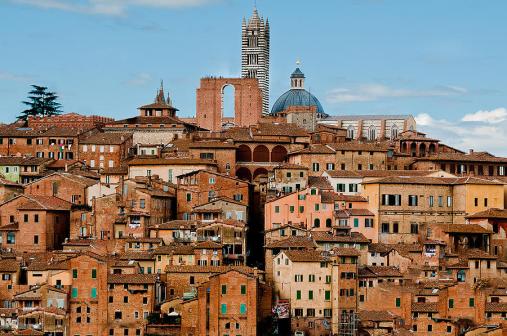
Traveling through Italy with only a rudimentary grasp of the Italian language and customs has proved an adventure we have shared with the Steinbecks, as well. Steinbeck writes about getting lost in Rome – which we have never done – but we have had a hell of a time reaching our hotel in Siena the first time we visited. Like Steinbeck, we couldn’t actually claim that we got lost because we had so little idea of where we were that we were unsure whether we were lost or found. Driving our rented Mercedes to Siena from Florence we followed the road signs indicating that the best way to reach the city involved driving up the front of the mountain: so we did. We arrived at a car park filled with tourist coaches and proceeded to search for our hotel to no avail. It was about a block away but we could see no route by which to reach it. The tourists we asked were no help – they were as unsure of their location as we were – and the Italians insisted that we return down the mountain because we couldn’t get there from here. Jamie began to swell like a pressure cooker. Finally we met an Italian man who explained in a way that we could understand – that meant in more English than Italian and with lots of gesturing around and to the right – and we headed back down the mountain. At the roundabout, we turned right and followed the road past the mountain upon which Siena sat.

“Are you sure this is what he said?” I asked, as we seemed to be going pretty far out of the way to reach a hotel that was supposedly located immediately behind the building we were formerly parked in front of twenty minutes ago.

“Yes, this is what he said,” Jamie hissed through gritted teeth. We passed the soccer stadium and the first right was a tiny street, more a block-paved Roman track than a real road. The road climbed the mountain quickly and with a far steeper pitch than the circular one we had accessed before. Near the ancient stone walls of the city, near the top of the steep incline, Jamie commanded, “Open the window and look to the right. Do you see three flags?”

I unhooked my seatbelt, hung out, and prayed. Indeed there were three small flags in the distance. “Yes,” I answered.

“Good,” he snapped and jerked the car to the right.

It was a narrow pavement filled with shoppers, dawdlers, tourists, and employees on their lunch hour. “You can’t drive here!” I shrieked. “It’s a sidewalk.”

“It’s not; it’s a road.”

“Well, it’s a damned slender one and stuffed full of people.”

“Who cares? It’s a road so let ‘em move.”

We continued along the pavement, past a couple of banks, a grocery store, and several small shops. Apparently he was right about it’s being a road because a few tiny Smarts were parked on the fringes of it and the idlers and perambulators did segue out of our way. In a few minutes the tiny flags had become life-sized and appeared to be attached to a hotel.  Jamie stopped directly in front of them. The glass door opened and a uniformed bellman came out and popped the trunk.

After checking in we wandered the streets for a bit and ate a delicious lunch of local food at a small sidewalk café. Jamie started rumbling about needing a nap so we returned to the hotel.

I awoke before Jamie, just as the sun began its descent behind the ancient buildings circling the campo. Wanting to see outside, I popped the window latch so I could open it, but not enough to cause the air conditioning to shut off automatically, a rather nifty function I have noticed only in Italian hotels. I stuck my head out to see what was going on in the street below.

It is obvious that I am a city child and began my windowsill-leaning early because I am really adept at it. I should be: I learned how to do it by watching my grandmother in the Bronx when I was very little. I pulled a chair to the window and rested my folded arms on the sill and then my chin on my arms. It is the most comfortable position to view the theatre of the street.

Below me a large crowd was marching – not just walking together but actually marching – carrying burgundy banners and flags decorated with the image of an elephant. The crowd was composed of people of all ages – nonne e nonni hobbling arm in arm, children racing and tagging each other as they waved their flags, and clusters of young men and women striding with clasped hands.

“What are you watching?” Jamie asked from the bed.

“I don’t know. It’s some impromptu, disorganized-looking, parade.”

He rose and walked over to hang over my shoulder. After watching for a while, he tried calling down. “Hey! Hey!”

A young man looked up.

“What’s going on?”

“Il nostro contrade ha vinto il Palio!” he yelled.

Jamie stared at me. “What does that mean?” he asked.

I shrugged. “Ask the front desk.”

After calling the Concierge, we learned that the neighborhood, the contrade, in which our hotel was located, had won the annual Palio, a traditional, medieval horse race run around the Piazza del Campo. We wandered downstairs and stood outside and watched the parade, which, by now, had grown so large and boisterous that we were smashed against the stone wall of the hotel.

Two rowdy and over-excited teenage boys were roughhousing and crashed into us, sending both of us sprawling on the pavement. An older man grabbed the boys and shouted at them in Italian while some others helped us up and brushed us off with murmurings of “Scusi” and “Ci dispiace.” The man who had grabbed the boys was shouting, “Vai scusa per la bella gente!” while pointing at us. The boys approached, hung their heads sheepishly, and muttered “mi dispiace” nearly inaudibly.

“No problem, really,” Jamie assured them.

As the boys scarpered off, the man explained in mostly Italian and partial English that the boys were ecstatic because their horse had won the race. Jamie kept gesturing and nodding, “it’s okay, it’s okay” but the man continued talking, waving his arms animatedly the whole time.  When he finally stopped, he stared at us as though he expected an answer. We remained silent. Finally he asked, “bene?”

Jamie looked at me. I said nothing so he poked me. “Oh! Oh! Sure! Bene! Va bene!”

The man turned and began to walk away. Jamie and I looked at each other. Then we realized that he had turned back and was waiting for us. “Bene?” he asked again, motioning us to follow.  We stared. “Would you . . . don’t . . . like to eat?” he asked.

One of those cartoon lightbullbs I am so famous for clicked on in my head. I grabbed Jamie’s arm. “I think he wants us to come with him to their block party.”

I thought fast and tried to translate in my head as I turned back to the man. “Vuoi . . . che andiamo . . . al . . . party?” I asked awkwardly.

He frowned as he translated my poor Italian. “Si,” he answered finally. “Vogliamo che a partecipare il nostro . . . party.”

Jamie is never backward about going forward as the Brits say. He grabbed my arm. “Come on!” he exclaimed. “Let’s go! Can you imagine how good that homemade Italian food is going to be?”

So we attended the contrade party. Huge trestle tables were set up along the main street.   They were filled with food, laden with food.  There was so much food that no adult slapped away little hands grabbing surreptitiously, even though the priest had yet to offer thanks for and blessings on the meal.

Music played, wine and beer flowed, and, just as Jamie had predicted, the food was beyond the best Italian food I have ever eaten. The people of the contrade were gracious and welcoming, setting places for us, heaping our plates, refilling our glasses with homemade red wine, and finally, introducing us to their horse and jockey. We stayed until nearly 3 am, laughing, drinking, dancing, and petting the horse.

We stumbled back to our hotel in the inky blackness, waving our contrade flag in the misty rain, certain that we would never have another night like that again, when total strangers welcomed us into their celebration as fully and easily as if we were their long-lost relatives. Siena has lived in my heart ever since and the small elephant flag flies at my house every summer.


The Morning of the Manny Hanny Guy

th

Despite my deep and abiding belief in Feminism I have never been offended when a man flirts with me. Maybe this is because although I have always been considered attractive, I have never been a classic beauty, and it didn’t happen very often, even as a young woman in New York City. Regardless, as long as the man isn’t crude (the ‘hey baby’ of construction workers springs to mind) I try to take it in the spirit in which I hope it is intended.

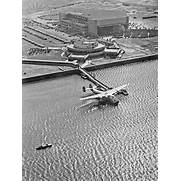
One sunny, July morning I had to take the early shuttle from the LaGuardia Marine Air Terminal to DC for an SEC meeting.  It was a beautiful, clear, day and I was wearing a black linen dress with matching jacket and had a black grosgrain ribbon tied at the bottom of my French braid.  I was sitting in the airport lounge fiddling with some legal paperwork and waiting for my colleague to arrive.  A tall, handsome man walked up to me, stopped in front of my seat, and reached out his arm to me. I cocked my head to the right and stared at him like a quizzical spaniel. He jiggled his hand slightly so I could see that whatever he held in it wasn’t going to explode. I reached up tentatively and accepted a little grey plastic box marked ‘Manufacturers Hanover Trust.’  I gazed at the box, then up at him questioningly. He smiled and said “I always carry an extra to give to the most beautiful woman I see.” My eyes grew large and I mumbled a baffled “thank you.”

He bowed slightly, turned, and walked toward the line for his shuttle to Boston. I snapped open the box and saw that it contained mini office supplies – clips, scissors, and a tiny black stapler with extra staples.  I smiled. I raised my head to find him in line. I caught his eye as he inched forward in the queue. I held up the box and grinned at him. He smiled in return then handed his ticket to the gate agent.  I never saw him again.

That was 1986.  I was 26 years old.   I remember everything about that day, maybe because a total stranger made it wonderful by flirting with me, by telling me I was beautiful, and by asking nothing in return.  So, wherever you are, Manny Hanny Guy – thank you. By the way, I still have the box.

Keds Hanging on the Line

th

When I was little, my family would leave the city on Friday evenings in the summer after my dad and grandfather returned home from work. The drive on the Taconic was long and boring so, after the fun of annoying my sister wore off, I generally fell asleep, waking when we pulled into the gravel driveway; the second the bumping of the car stopped I would fling open the back door and hop out to run across the acre that my grandfather always kept fallow. It didn’t matter that it was dark and the field was rutted or that I would have to return home in about thirty minutes for dinner. Nothing mattered but seeing my best friend, Patti Reyman, who lived in the house at the other side of that field.

Sometimes, though, we arrived closer to midnight because my father had returned from work late or an accident on the Thomas E. Dewey Thruway had marred our progress. On those nights I grabbed my stuffed dog, Morgan, and headed to bed, knowing that Patti would be waiting for me the next morning.

Patti and I had known each other forever because her father, Louie, and my father were childhood friends. When my grandparents were first considering buying a weekend house, Louie drove upstate for the ride; while there he fell in love with a local girl. He relocated to be with her and soon they married and began their family of four girls. As Patti and I are the same age, we became the fastest of friends, playing together all day of every summer day until high school. The bond we forged remains to this day.

The next morning, no matter how eager I was to go, there were protocols to be followed. First, I had to have breakfast with the family. My grandmother thought that the minimum amount of food required to start the day was a small glass of juice, a bigger glass of milk, and bowl of cereal; woe betide the grandchild who tried to sneak out without having finished it all. Next, I had to have my long, blonde hair arranged into twin pigtails by my sister – who pulled while she braided – or my mother – who did not. Finally, I had to dress in suitable play clothes because Patti and I were not docile little girls who played Barbies – when we played, we ran, we chased, we fell . . . we really played – so no girly, lacy, sundresses for me. Easily-washed shorts and sneakers were my summer uniform and I was eager to be in it and be off.

Finally I was flying across the dewy grass glistening in the clear, summer sunlight. Patti opened the sliding glass door before I even banged on it.

“I knew you were here because I saw your Keds hanging on the line,” she said.

That was over forty years ago, and now the seasons seem to fly past, but when the weather turns mild and the daylight stretches itself up on its tiptoes, I crawl up into the attic and dig out my Keds. (Yes, I still wear them.)

When Patti and I chat on the phone or text each other and the conversation turns, as it often does, down the road of childhood, amidst the memories of attending the band concerts in the gazebo in Hoosick Falls or the time my cousin, Carl, locked me in the playhouse, she invariably mentions the sight of the sneakers dangling from my grandmother’s clothesline. “I so looked forward to seeing them; that meant that you were here so it was officially summer.”

Official summer is an emotional designation having nothing to do with the solstice. It’s officially summer when I shut off my alarm. It is officially summer when juicy, scarlet strawberries appear at Moses Farm Stand. It’s officially summer when I pack for Italy. And it is officially summer when I can spend my days with my dearest friends while clothes on the line waft in the breeze.