Greetings from Hell, New Jersey

th-1

A few years ago my employer thought it would be beneficial if the staff went on a camping trip together, to bond as a team. I saw no need for this. Having grown up in New York City and attended day camp in Central Park as a child I knew that camping was horrible – all that unbridled nature gave me the willies – and that the team could bond just as well in a room, preferably one serving food and drinks. After all, Jamie and I went to the Top of the Sixes on our first date and we bonded so well that we got married, so certainly an evening in a party room of a nice hotel would be a better choice; but no, a camping trip it was to be.

When I told Jamie he burst into laughter. “Camping where?”

“What do you mean, ‘camping where’? Outside. In the woods. You know, nature, like upstate all around my grandparents’ house.”

“In the woods?” he hooted. “You don’t go near woods. You barely walk up to the fruit trees in our back yard. When we attended Terry’s wedding on the Vineyard, all you kept saying was, ‘Ugh, I bet there are ticks here.’ Remember?”

“Well, there probably were ticks everywhere. Terry’s family hadn’t even mowed the lawn in a decade.”

He changed the subject slightly. “What are you going to sleep in?”

“Pajamas. What did you think?”

Jamie made that expression that my mother often makes at me, as if I hear a different tune than the one the band is playing. “No, I meant, a cabin? A tent? Just a sleeping bag near a fire?”

I paled, horrified. “I had presumed a cabin, but now I’m not sure. You mean there might be no buildings at all?” Visions of rainy afternoons at day camp popped into my mind.

“You had better ask. I will buy you a sleeping bag on the way home from work tomorrow.”

I asked my boss the next day and it turned out that there were cabins with bunk beds with mattresses and hot showers. I breathed a little easier. Maybe this would just be like a rustic Holiday Inn, or like those little places that used to be all over Montauk before the gentrification began.

Jamie came home with a blue, mummy sleeping bag, meaning that it was shaped like a mummy’s casket so it stayed close to the body and was, therefore, warmer than a regular rectangular-shaped one.

I packed pajamas, a t-shirt, a sweatshirt, socks, underwear, my laptop, and a book in my largest Goyard tote bag and tied the sleeping bag’s strings to the handles. I figured that I would wear the same jeans and sneakers both days. Easy peasy. This might actually not be so bad, as long as it didn’t rain.

The next afternoon, when I met my colleagues at the bus hired to drive us to the campgrounds, about an hour and a half outside of New York City, I noticed that I was carrying very little compared to them. After we arrived I discovered why. Choosing bunks in the cabin, I saw that all of the other women had brought covers for the mattresses, pillows, and towels. Since I had never before gone anywhere where linens were not provided, those things had never occurred to me. My insides began to quiver slightly.

They had also brought coolers of food. “Wait, don’t they feed us here?” I asked beginning to get really nervous – sweaty-palmed nervous – now.

Betty, one of my co-workers nodded. “Yes, but camp food is always bulky – you know, reheated, fatty and carby, like prison food. I prefer to bring my own.”

At that, visions of institutional mac and cheese and baloney on white bread sandwiches began to pirouette through my head. “You mean, they don’t cook fresh food?” I gasped.

“No,” she replied in a strange tone as if laying eyes on me for the first time.

“Well, maybe I will call out for pizza,” I said, only barely joking.

Patty, another co-worker, laughed. “There is no cell service here!” she exclaimed as if stating the obvious.

My heart began banging. Hell, if I’d known all that, I’d have brought my mom’s leftover lasagna and the box of Jaques Torres chocolates from my bedside table. And no cell service? Why had no one thought to tell me? Where the heck were we, anyway? Through ears filled with a noise like pounding surf, I thought I heard someone mutter something about there always being plenty of peanut butter in the dining hall.

Betty had noticed the panic in my eyes. “Laura, have you ever been camping before?” she asked.

I stared at her, defeated. “Does one week of day camp in Central Park count?” I asked dismally.

She caught her breath. “Why did you agree to come?” she asked.

“I was unaware that I had a choice.”

She thought about that. “That’s probably true,” she agreed. “But all of us love camping. We do it with our families. I suspect that you aren’t going to have much fun here this weekend.”

That was an understatement. The bunks were wobbly, the plastic-covered mattresses were thin, the hot showers were lukewarm, and I had to dry myself with my sweatshirt – which then stayed damp because it drizzled most of the weekend. I ate sticky peanut butter on gummy white bread for every meal. It was hard to even participate in the bonding exercises when I felt soggy and bloated. The only good part was crawling into my mummy sleeping bag at night.  On Sunday morning I was the first one on the bus to return to New York. When I finally got a cell signal on the New Jersey Turnpike I burst into tears when Jamie answered his phone.

“Where are you?” he asked.

“Turnpike,” I snuffled, wiping my nose on my sweatshirt sleeve.

“Where was your retreat?”

“Hell.”

“Hell, New York; Hell, New Jersey; or Hell, Pennsylvania? I hear there is one in every state.”

“Hell, New Jersey. Meet me at the bus. I want a hot shower. And a towel. And a hot meal.”

“I will be there.” He clicked off.

I never went on another staff camping trip; rather than be faced with the possibility of another one, I transferred out of that department.   My mummy sleeping bag snoozes in its carrier bag and I have never again used a sweatshirt for a bath towel. My life remains all the richer for it.

And to All, a Good Night.

fullsizerender

I loved Christmas when I was little. There were sweet and savory aromas wafting from the kitchen for weeks leading up to the big day. There were holiday movies and specials on TV. There were brightly wrapped gifts under the fresh-cut pine tree tempting me with their sizes and shapes. (If it was square and light and came from Mommy and Daddy it must be underwear.) Best of all, there was a trip to see Santa.

Depending on where we were, sometimes I saw several Santas – the one at Macy’s at Herald Square, the one at the Albany Montgomery Wards upstate, the one at Marshall Fields while visiting Uncle Fritz in Chicago, and the one at Joseph Horne Co. while visiting my mom’s family in Pittsburgh. All of these Santas looked and spoke slightly different and early in my childhood I wondered how there could be so many of them. After all, one must be the real one, but which one. My father tried to explain it to me.

“There isn’t only one real Santa,” he said. “Santa is the spirit of giving and that is why he can visit every child in every land, no matter what color or religion they are.”

Oddly enough, even at age four, I understood that. Actually, I found it a relief that Santa was so egalitarian that he would visit me, a half Catholic/half Jewish/now Protestant child. No matter at which relative’s house I happened to be sleeping on Christmas Eve into morning, after my dad read The Littlest Angel, parts of A Christmas Carol, and the Christmas story from the Bible, I kicked off my reindeer slippers and crawled under the covers secure in the knowledge that Santa would find me, that he would find all of us no matter what color, creed, ethnicity, or religion because he wanted to, because we are all equal to Santa.

The older I get, the more I appreciate my dad’s explanation and the more convinced I am that he was right.

Merry Christmas to all.

We Don’t Need Any More Furniture.

img_4913

A few years ago Jamie and I drove up to Maine for a long weekend with friends, Julie and Eric Cook. We would be staying at Eric’s family’s summer home on the water and Eric and Jamie would go fishing while Julie and I wandered through an antiques fair. We had driven up in two cars because Julie was sure that she would find so many terrific things at the fair that she would need both the trunk and back seat of their BMW 740iL to contain them all.

I think her certainty caused Eric to quake in fear; it certainly gave Jamie pause, as he hoped that her acquisitiveness would not influence me since, left to my own devices, I am already a world-class shopper.

Early on Saturday morning, as we drank coffee in preparation to depart Eric looked nervous.

“Jules,” he said for about the eighth time. “We only have the one car. The trunk is full and I don’t want stuff damaging the leather on the back seat. Don’t buy anything too big.”

Julie crunched her toast and stared at him. “Jamie and Laura have a car, too. They can help us if I find great furniture.”

Jamie almost choked on his juice. He wiped his mouth and turned to me. “Furniture?” he hissed.

I shrugged. “I’m not buying furniture,” I whispered back. “I just came along for the ride.”

Eric refilled his coffee mug and turned to face Julie who was loading her mug and plate into the dishwasher. “Jules, our house is full. We don’t need any more furniture.”

Julie exhaled and looked at him directly. “Eric, you know perfectly well that we aren’t staying in that little house forever. At some point we will have children and we will need a bigger house; a bigger house requires more furniture and it is just cost effective to buy what you need when you see it rather than trying to furnish an entire house at once. And you also know that I have been looking for a jelly cabinet and a linen press for years.”

I had the feeling that this discussion had been going on for at least as many years as she had been shopping so I excused myself to get my purse and shoes. After loading our dishes into the washer I dragged Jamie with me out of the kitchen and up the back staircase to our guest room.

“We don’t need furniture,” Jamie announced as his foot hit the first step.

“I am not going to buy furniture,” I retorted grumpily pushing him up the stairs in front of me. “Geez, I have already said it.”

“You know what Julie is like. She sees stuff and she doesn’t consider the price or where it’s going to go. She never even seems to know how big things are. That’s how they got that massive four-poster bed that fills the entire guest room of their house.”

“That’s also how we got that massive Bajan mahogany bed that fills our guest room,” I reminded him, “only you chose that. And that required a custom mattress, as well.”

“Right, so we don’t need more furniture.”

I sighed. “I know, James.” I slid on my Keds and grabbed my tote bag and left him in the bedroom.

Julie drove their car to the antiques fair. I sat in front bearing the brunt of her foul mood while Eric’s mother napped in the back. By the time we reached the fairgrounds, Julie had pretty much vented all of her aggravation and was considerably cheerier as we paid our parking fee and began to stroll through the acres of goodies.

We wandered for hours, but Julie was unable to find a jelly cabinet or a linen press that met her exacting standards, although she bought an entire set of beautiful sterling silver flatware in the lily-of-the-valley pattern. I bought a couple of antique pub bottles and a Victorian basket cat carrier for Tuxedo. Eric’s mother bought nothing.

At about 4 pm we reentered the hot car for the hour’s drive home. Despite not finding her heart’s desire in any of the furniture stalls, Julie was thrilled with her silver purchase. As we approached a red light in a congested intersection with a gas station or convenience store on every corner, Julie suddenly grabbed my arm. “Look!” she exclaimed, pointing in front of us.

It was a gas station that also had a U-Haul rental office. Parked in the lot was a rather large truck with a sign on it that read “Rent Me for $19.99!”

“You’re not!” I exclaimed understanding immediately.

“Oh, yes, I am,” she replied flicking her hand across the turn signal switch. “It’ll give Eric a heart attack when he sees us drive up in that. He deserves it. Jamie, too.”

“But what about your car?” I asked.

“Eric’s mom can follow us in it. Wake her up.”

And that is what we did. Julie rented the truck and she and I rode home in it, bumping up the long, rutted, gravel driveway to the house. We could see Eric, Jamie, and Eric’s father sitting on the wide front porch, enjoying a beer in the waning light as they awaited our return. When we got close enough, we could also see their eyebrows shoot straight up and their mouths all fall open as they realized who was in the truck.

Julie parked haphazardly and we both hopped out. Eric’s usually tanned face was the color of oatmeal.

“What have you done?” he shouted as he stumbled down the porch steps.

“What do you mean?” Julie asked, blue eyes opened wide. “You said the trunk was full and you didn’t want our purchases to damage the back seat. How else are we going to get our stuff home?”

Hyperventilating, Eric pushed frantically at the heavy latch holding closed the back door of the truck. As he caught his breath, I could see Jamie and Mr. Cook walking slowly toward us. Their pace quickened as Eric exhaled, “Oh, my God!”  Reachng the truck, they both peered in slowly, as though frightened at what they would see.

The vast truck bed was empty. Julie and I started to laugh as Eric nearly collapsed onto the grass.

It was the last time either Eric or Jamie told either of us what to buy.

Christmas, 1994, Manele Bay, Lanai, Hawaii   

fullsizerender-2fullsizerender-1fullsizerender-3fullsizerender

Cross-legged on the canvas,

slicing through the turquoise.

Above me, yellow and ivory sails billow.


You stand on deck,

steering with Patrick

while Lauren and I laugh and reach toward the dolphins in our wake.


Time blurs the images in my mind,

leaving them grainy

and slightly fuzzy around the edges.


When it is cold here

I long for those hot December days

of squinting in the sun.


Living in the Heart of the English Eccentrics

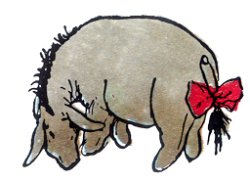
classic_eeyore

My affection for Great Britain began when I was a teenager. Watching To Sir, With Love and There’s a Girl in My Soup on the Million Dollar Movie or The Persuaders and The Avengers on television while babysitting allowed me to fall in love with the sight, sounds, and ambience of London: then when my mom handed me a copy of Forever Amber by Kathleen Winsor, I was forever hooked on British history, as well. That is how I found myself enrolling at Oxford University – an eccentric American in the homeland of the English Eccentrics.

After landing at Heathrow and taxiing into Central London, it was still too early to check in at The Dukes, the hotel where I planned to reside for a week while acclimating to the time and culture change. So, after dropping my bags at the hotel, I began to wander around Piccadilly absorbing the sights and sounds of the city. I ate breakfast at Fortnum and Mason and bought a scarf at Harvey Nichols and a teapot at Harrods. Passing Hamley’s on Regent Street I saw a window display of stuffed recreations of the original Winnie the Pooh characters, not the Disneyfied ones, but actual remakes of the ragtag stuffed toys belonging to Christopher Robin Milne, the ones that inspired his father to write the Pooh tales. I tugged at the heavy glass door and entered the shop.

My friends and family members have always likened me to Pooh characters, although they disagree  as to which I most resemble; some say Piglet and some say Eeyore. Evidently I am both nervous and expecting of misfortune. I stood before the display wondering which stuffed friend I would prefer to take with me to Oxford; finally, feeling more resignation than anxiety, I chose Eeyore. I carried my purchase back to The Dukes and placed him on the bed, the same location my stuffed animals at home inhabited.

My week in London passed quickly and in no time I was ensconced in Room 3 in Stairway Six at Trinity. Repeating the gesture, I nestled Eeyore against the bed pillow.   When classes began, I – no early riser by nature – raced out of my room in the morning, leaving Eeyore buried in the covers. This posed no problem as each student room was tidied every day by the scouts and each day Eeyore was recovered from his suffocating, premature burial spot; but instead of finding him centered on the bed or perched on the pillow, every afternoon when I returned to my room, Eeyore was somewhere else, engaged in some activity, sometimes with small notes written on scraps of my notebook paper and tucked between his front paws. The first day he hung from the ceiling light fixture by his back paws with the note, “Don’t worry. I won’t jump.” Another day he sat next to my Harrod’s teapot with the note, “Time for a spot of tea.” Yet another day he sat atop my laptop with a pencil between his paws and the admonition, “Must get some work done.”

This continued for the entire time I was at Trinity. Finally, as I was packing to return to New York, a man carrying a duster poked his head in the door.

“Hello. I just wanted to see who lived in this room.”

I looked up and smiled. “Oh, me. Laura.” I held out a hand.

The man shook it and, grinning shyly, introduced himself as Ian, the scout responsible for my floor, then, as he gazed around the room, he asked, “Where is Eeyore?”

“Oh, he’s packed for his plane ride to JFK,” I answered. I furrowed my brow. “Are you the person who brought him to life during the day in my absence?”

Ian blushed. “I am. I was just having a little fun. I hope I didn’t offend you.”

“Offend me? No, I loved it. I took photos of him every day when he was doing something. I was disappointed on days when you didn’t do it.” I turned to the desk and pulled out a folder from a stack of notebooks. “Look. I saved all of your notes.  I am American and was feeling really frightened and lonely at first. Your notes brightened my days more than I can say.  Thank you.” Ian’s blush deepened as he turned to leave and continue with his cleaning.

I still have Eeyore. I still have all of the notes Ian wrote for Eeyore. And I knew that I had found my spiritual home in the aloof, yet kindly bosom of the land of the eccentrics.

City Mouse Gets a Tractor

fullsizerender

There is a tractor in our garage. It lives there. It is a 1946 FarmAll Cub and it belonged to my grandfather.

Those of you who know me are aware that my family life began in an apartment in the Bronx, so you may wonder why I have a tractor, or even why my grandfather had one.

When my dad was about fifteen years old, my grandparents bought a couple of acres upstate; even though my grandfather had no intention of farming per se, he held the concept of it in a warm and secret place in his heart, and his first purchase was a brand new, shiny, red tractor in silent homage to the source of that secret place.

When my grandfather was a child, his beloved mother died giving birth to twins (who also died); in his grief and – to hear my grandfather tell it – drunken incompetence, my great-grandfather couldn’t handle the older children and all but gave them away to virtual strangers to foster them. My grandfather ended up with the Van Dykes, a farm family in the Bronx, in the halcyon days when the Bronx was acre after acre of meadows and dairy farms, before concrete and city housing swallowed up the land. The family was so kind to my grandfather and he loved them and their way of life so much that even though he was a city child, he resolved to recreate that bucolic time in his later life, albeit on a far smaller scale. (I understand that completely because I did exactly the same thing when Jamie and I were looking to buy a house. I chose a brownstone Dutch colonial with two acres, fruit trees, chicken and turkey coops, and a grape arbor. My grandfather’s tractor, which had until then been living with my parents, came to live in our garage.) So he bought the land and the tractor and, as he never really farmed, the tractor never really worked. It was more my grandfather’s friend and companion than an actual tool and he spent hours tinkering with it out in the tractor house (no, not a garage – my grandfather built his best friend its own little wooden structure where no car or motorized vehicle dared show its headlights).

Admittedly, I don’t drive the tractor a lot, especially after three knee surgeries. I mostly turn it over every once in a while to be certain that it still runs. And I keep a trickler on the temperamental battery to keep it from dying. Besides, Tractor doesn’t really want me to drive it. Although while my grandfather lived it let all of us – children and grandchildren – drive it, Tractor only really liked my grandfather. Where the running noise with my grandfather was a throaty, rumbly, purr, the noise it makes for the rest of us is a groan, followed by a series of higher-pitched mechanical whines. I understand. Tractor misses my grandfather as much as I do and the only way it can show its unhappiness and discontent is by flooding the engine when I am attempting a three-point turn in the middle of a main county road.

Although, now that I think of it, Tractor has always had a way of expressing its displeasure, if anyone else dared drive it when my grandfather wasn’t around. My grandfather had purchased a little umbrella attachment to shield himself from the summer sun while he mowed or pulled all of the neighborhood kids in a big, red, wooden, wagon that he built. Once when my mom drove Tractor while my grandparents were still in the city, she forgot to pull down the umbrella as she swung into the tractor house snapping off the top. I was only about three year old but I could have sworn that I heard Tractor chuckle in delight at my mother’s misfortune.

But I love Tractor even though it is cranky and uncooperative. After all, it is seventy years old and entitled to enjoy its retirement. Mostly, though, it is a tangible piece of my grandfather that I still have with me forty years after his death.

A Night on the Town with Jack, Nicol, and Rory

fullsizerender

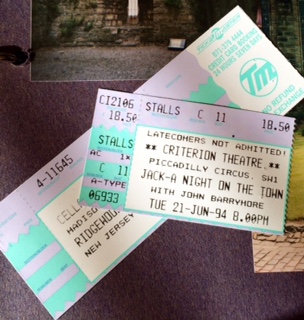
June 21, 1994. My first week in London alone. I bought a ticket to see a one man show, Jack – A Night on the Town with John Barrymore, written by and starring Nicol Williamson. I had read about the play in the newspaper and I loved Nicol Williamson and I loved John Barrymore so this show seemed a perfect choice for me.

I arrived at the Criterion Theatre in Piccadilly Circus a little early due to the habit of a lifetime. (To my father, on-time was late). I chatted to some of the other audience members. Actually, there were so few, I think I chatted to all of them until the lights dimmed.

Nicol Williamson bounded onto the stage in a roaring Barrymorian vocal flurry, like a pot verbally boiling over in fury and shame at being fired from the film A Star is Born. He stalked the stage, trench coat tossed elegantly over his shoulders, then stopped suddenly upstage left and poured himself a drink. Crystal glass in hand, he prowled downstage to tell us, the audience, of his travails on Broadway, in Hollywood, while married. In all of these scenes, Williamson’s acting was pitch perfect, embodying Barrymore’s admirable and less admirable qualities with a wry and witty tone. The time flew by. When the curtain came down I clapped as wildly as everyone else in the theatre. After taking his curtain call, Mr. Williamson motioned for the applause to die down, for everyone to sit, and then, breaking character, he began to talk about the play. He talked about his lifelong affection and admiration for Barrymore, both personally and professionally. He mentioned what it is like to be considered a difficult actor to work with, something he knew from personal experience, he confided to audience laughter. He talked about how this performance was a risk for him, an experiment, but one near to his heart. He thanked all of us for coming and then, suddenly he invited every person sitting there to join him for a drink as a way of thanking us for believing in him and his dream. He said that he would meet us in the bar of the Criterion restaurant next door within thirty minutes, then he swept from the stage.

Most of the audience members stared at one another.

“So do you think he is serious?” asked a woman seated three or four rows behind me with her husband.

“I don’t know,” I shrugged.

“But will you go?” asked a man’s voice in front of me.

I thought. “Sure, why not? The worst that will happen is that he is either kidding or will change his mind and I will have to pay for my own drink.”

My fellow audience members murmured to one another, agreeing with me and wondering whether the effort was worth the reward.

I stood and picked up my Armani linen jacket from the seat back. “Well, I am going. I have nowhere to go and nothing to lose.”

“Me, too. I will go with you,” came the voice of the man in front of me. “My name is Rory, by the way.”

“Laura.”  We shook hands and grinned at one another.

We exited the auditorium and scuttled through the crowd to the lovely and elegant bar area of the high-ceilinged Criterion restaurant. Rory and I chose two of the red chairs arranged in cloverleaves around small wooden tables and ordered. He got a beer and I ordered a sparkling water. We chatted a few minutes about our homes and families, and then some of the other audience members began to trickle in, chattering about the show and the bizarre invitation by the star. We joined their discussion. It was odd; I grew up in New York City but had never heard of a Broadway star inviting a theatreful of people for a thank you drink for enjoying his show.   The incongruity of the circumstances and the proximity of alcohol soon turned disparate theatergoers into a raucous assemblage of friends.

Within forty minutes or so, Nicol Williamson entered and the real party began. I don’t know whether he was drunk or just having a good time now that his night’s performance was over, but he was funny and charming, much as I imagined John Barrymore must have been. He asked me where I got my accent and how long I would be in London. When I said that I was on my way to study at Oxford, he began to recite lines from Hamlet with such passion and power that I developed goose bumps.

Then, almost in a puff of smoke, he stopped, stood, and was on his way to work the room, to sit at the next table, to thank those people for coming.

Rory and I chatted for a few more minutes then I began to yawn. He offered to walk me the few blocks to The Dukes. On the way we chatted abut how truth is stranger than fiction and how none of our friends would ever believe that this had happened.

We reached the gas-lit cul-de-sac of St. James’s and the liveried doorman opened the heavy glass door. Rory said goodnight, kissed me on the cheek, turned, and whistling, disappeared into the summer night.

Be Careful What You Wish For

th

There is something about camping that has always captured my imagination – the crisp nights, the aroma of meals roasting over a wood-scented fire, cuddling deep into a warmly-quilted sleeping bag and waking into cool, moist air aromatic with delicate pine.   Doesn’t it sound terrific? It does to me. In theory, that is, not practice. In practice it is a cold, wet, horror show for a child of the Bronx.

When I was five I begged my mother to allow me to go to day camp in Central Park like all of the other neighborhood kids did. I was lonely during the long summer days with everyone gone; there was no one to play with except my older sister – who didn’t appreciate my constant attempts to trail after her as she finagled ways to meet her current inamorata, Joe DeFalco, in DeVoe Park – and my cousin, Carl – whose ideas of interesting places to hide during hide-and-seek included the boiler room of our apartment building, which nearly got me cooked by the heat then flayed by the building janitor in that order – so, generally, I sat at the kitchen table coloring alone. Going to day camp meant assembling with the other kids on the corner of Fordham Road and Grand Avenue in the sweet, morning air and riding a big, yellow, bus into Manhattan, singing road trip songs like “Ninety-nine Bottles of Beer on the Wall” the whole way. It meant a packed lunch and a day spent in the big park where there was the Balto statue and the Alice clock and other amazing landmarks that I loved to see. I campaigned for permission in the same way my dad said they voted in Chicago, early and often.

“Mommy?”

“What?”

“Can I go to day camp?”

“No.”

“Why not?”

“You won’t like it.”

“How do you now?”

“Because I know you, my little cherub.”

Unsure what that meant I asked.

“It means that you don’t like to be too hot or too cold. You hate getting wet and you abhor getting dirty.”

“What does ‘abhor’ mean?”

“It means you aren’t going to day camp.”

Finally, weary of my persistent entreaties, my mother enrolled me in day camp. I was ecstatic.

“It’s only for one week,” she warned.

I was puzzled. “Why?” I asked, knowing that the other kids went for the whole month.

My mother raised one eyebrow and pursed her lips as she gazed at me. “As I have said before, Laura, I know you and you won’t like it.”

Hmmmmmm, we’ll see, I thought as I trotted down the hall to my room to choose my entire next week’s wardrobe.

That Saturday, two days before day camp began, I watched as my mother took an empty Charles Chips tin and began filling it. She inserted my Fordham University sweatshirt and a small first aid kit. There was still room at the top, which she explained was for my lunch and my thermos. Then she took an old pillow and an oilcloth table covering and began to make a small, flat, cushion, which she proceeded to glue to the lid of the can. While that was drying, she pulled an ice pick from the kitchen utensil drawer and a hammer from under the sink and punched holes in the tin, one on either side, then strung clothesline through it.

“What is that?” I asked as she fitted the padded lid back onto the tin.

“The day camp counselors call it your sit-upon,” she said. “You carry it by this rope handle with you every day and it holds everything you need, plus you can sit on it for crafts, for lunch, for storytime.”

“Neat!” I was growing more excited by the minute. I ran my hand over the cool and slick oilcloth cover and felt a sudden, inexplicable frisson of concern. “Mommy, this fabric is slippery.”

My mother looked up from the kitchen sink where she was washing the glue from her hands. “It has to be. They said it has to be waterproof.”

“Why?”

“So it repels the rainwater.”

Rainwater? My brain started strobing like a disco ball. “What rainwater?”

She dried her hands on a tea towel and bent to hang it on the thin, chrome, rod fastened to the cabinet. “When it rains. If it rains.”

“Don’t we go inside when it rains?”

She laughed. “Of course not. It’s camp. The only ‘inside’ available is the picnic pavilion.”

I knew what a picnic pavilion was; it was a floor and a roof, no walls.   It provided shade from the sun and little else. “You mean we just get wet?” I squeaked.

My mother turned to leave the kitchen. “Yup,” she called over her shoulder.

Oh. This was a new wrinkle. In my imagination there were cozy little cabins with stone hearths and merrily-burning fires like in that movie we watched where the characters went ‘camping’ in Yellowstone Park. ‘Well, maybe it won’t rain,’ I told myself. Summer in New York City was notoriously hot and sticky.

Monday morning dawned grey; the sky was covered with huge clouds that looked like a giant pile of greasy cotton balls spreading across the expanse. The upswelling plumes of hot, July, air was producing such visible turbulence in them they appeared to be boiling like dirty pasta water.

I stood on the corner with all of the other yellow slicker-clad children and clutched my mother’s hand waiting for the school bus. Now that the moment had come – and was a potentially wet moment – I was rethinking my decision. I tugged on my mom’s arm. She bent. “What if it rains?” I whispered. “Then you get wet,” she replied cheerfully. I sighed. Maybe she had been right about this, after all.

It was drizzling when the bus finally appeared. Dragging my Keds, I was the last one to climb aboard. As the bus blinked its amber lights and trundled away from the curb, I saw my mom through the window. She had popped open a bright red umbrella and was striding in the direction of Chock Full o’Nuts and Alexander’s. I could almost hear her sandals slapping on the damp pavement as she began her day of childfree fun.

I really don’t have to relay my experience. You can guess. It poured all day. Sitting in the pavilion the spin-art inks never dried because the cardboard absorbed the moisture and curled and the elbow macaroni for the necklaces sucked in the dampness and swelled up, then stained my pink t-shirt with the blues and greens I had chosen to paint it. My shorts felt like a wet diaper and my sneakers squelched when I walked. When the bus appeared to drive us home, I was the first one on it.

When the bus stopped at the corner of Fordham and Grand, I threw myself into my mother’s arms and burst into tears. “It was awful,” I wailed. “The rain never stopped and everything was wet and my top is stained and my shoes are ruined! I’m not going back!”

My mother listened then surveyed the situation for herself. I was wet; my top was stained; my shoes did indeed squish when I walked.   “Oh, yes, you are,” she contradicted me coolly. “You wanted to go and I paid for the whole week.”

So return I did the next morning. I finished the week hating every moment of it, wet or dry. I hated the constant activity, the forced cheeriness of the counselors, and most of all, I hated getting dirty or wet. But I learned that in life you must finish what you begin. Oh, and I also learned to be careful what you wish for; your mother may just make sure that you get it.

In a Jam, Preferably Strawberry, and Homemade, Please

th-1

Last Saturday morning Jamie came home with a huge loaf of French bread from Balthazar. He sliced several fat chunks from it, plugged in the toaster and, as it preheated, began rummaging in the refrigerator.

“Do you want something?” I called from the family room. I know from painful experience how much easier it is to offer help before he begins emptying shelves in pursuit of the invisible item that was directly in front of him the entire time.

“No,” he answered, slamming the door and moving to his left to rummage through the pantry shelves.

I tried again. “Can I help you find anything?”

“No.” The pantry door banged.  I heard the light switch click in the back hallway and footsteps descend to the basement pantry cupboard. Within thirty seconds he was standing in front of me, empty-handed and wearing an expression like a dog that cannot find its food bowl.

“Where’s the jam?”

“In the pantry. We have jars of it, all kinds, Italian lemon, Maine blueberry, orange marmalade.”

“Store bought?”

“Yes.”

“Where is your jam?”

I shrugged. “I don’t know. In the pantry, I guess.”

He shook his head mournfully.

I thought briefly. “Maybe we ran out.”

He looked as though he might burst into tears. “You didn’t make any?”

“Sure, Jame, I made strawberry and raspberry in June before I left for California.” I had spent a month in Pacific Grove taking a graduate class on John Steinbeck.

“I ate that while you were gone. You haven’t made any since you returned?”

“No. Sorry. I gained seven pounds out there and haven’t been eating toast.”

He turned heavily and wandered back into the kitchen. “I guess I will just use butter,” he sighed with the same air of resignation Louis XVI must have utilized when faced with the guillotine.

His reaction to a lack of homemade jam still surprised me after all these years. We were both raised on Welch’s and Smucker’s. His mother was a good enough cook but she never believed in making something herself that she could purchase just as easily. Her only exception was a version of Schrafft’s fudge sauce, which she made once a year or so and canned for use throughout the summer ice cream season. My mom never made jam, either, although she made any number of other things from scratch.   The only reason I even started making jam was because – in an effort to entice me to cook something, anything – my mom bought me a series of cookbooks for various holiday gifts when I was in my twenties. Upon visiting and observing the dust bunnies living atop them, she upped the stakes by one day walking through the front door of my apartment carrying a huge, silvery pot, shrink-wrapped in plastic.

“What’s that?”

“A canning pot.”

“Waddaya do with it?”

“You seal jars.”

“Mom, why would I want to seal jars? Don’t they come sealed? Isn’t the point to break the seal and eat the contents?”

My mother’s face got that expression of exaggerated patience she often employs with me when I refuse to see her point, however obtusely she is making it.

“When you can things.”

“Can things? You mean like your grandmother did?”

She smiled, pleased that I had finally made the connection. “Yes.”

“But I don’t know how to make anything.”

“You might want to some day, if you ever decide to stop living on Cap’n Crunch and Spaghetti O’s.”

The look on my face probably told her the likelihood of such a day coming was slim. After all, I didn’t need to learn to cook; there was always food around.  I lived in an apartment on Central Park West in Manhattan, not in the Little House on the Prairie.  She turned toward the spare bedroom, calling over her shoulder, “I’ll just put it in here until you want to use it.”

It sat there blocking my shoes for months until one day I passed a huge stall on the sidewalk selling fresh fruit to commuters. The strawberries looked great – plump and shiny crimson. “I wonder how hard it is to make jam,” I mused to myself. Deciding to try I bought six quarts and ran down the steps to catch my train.

I stopped at the Red Apple grocery on Broadway and bought two bags of sugar on my way uptown and dropped it all on the kitchen table after unlocking the apartment door. Kicking off my shoes, I petted Tux, then flicked on the light switch in the spare bedroom. I opened the closet and pulled out the enormous pot. “Come on, buddy,” I muttered to it. “Let’s see what you can do.”

Tux leaped onto the counter to help me slice the shrink-wrap and pull off the lid. Inside the pot was a metal colander-like thing and another shrink-wrapped package, this one holding six glass jam jars. I leaned to the right, blew the dust off the cookbooks, and slid out one entitled Southern Living Sweets and Gifts. Turning to the index in the back I found” jam, strawberry” pretty quickly. Scanning the recipe I decided that it didn’t sound so hard; clean and weigh the fruit, measure the sugar, dump it in the biggest and heaviest pot I owned with a candy thermometer, and let it cook until it thickened. I had my first batch of glossy red jam bubbling away on the stove in no time. Then I turned to the paperbound book tucked inside the canning pot to read the canning instructions.

“Oy vey!” I thought as I read all of the sanitary procedures required before even beginning. “No wonder Welch’s makes a lot of money. This is going to be a pain in the ass!”

The book showed all of the equipment I would require to complete this project successfully. Pot and lifter. (So that’s what that big colander-thing was.) Jars. Lids. Rings. Jar lifter. Canning funnel. Bubble remover. Candy thermometer. Foam scraper. A dishwasher for sterilizing the jars before filling. Suddenly I was sorry I had started this entire project before I knew what I was getting into. Well, it was too late to stop now; the jam was cooking and if I stopped it I would waste all that money and time, not to mention feeling like an idiot. I looked at Tux sprawled on the counter. “Hmm.  They say necessity is the mother of invention and mine is the mother who invented it. So we have to make this work.”

With Tux watching curiously, I dug through every cabinet and drawer in the kitchen until I had collected an approximation of the required equipment. Besides the pot, the jars, and the candy thermometer (another of my mother’s hopeful, yet unexplainable purchases for me) the rest of my equipment looked as though the cartoonist Rube Goldberg was going to participate.

I filled the canning pot with water and set it on the stove on the highest flame. I had no dishwasher then, so using hot dog tongs, I slipped the jars into the boiling water to sanitize and set the kitchen timer, then tossed in the metal lids and rings as an afterthought; too late it occurred to me that I had no idea how I would get them out. I slipped the thermometer into the bubbling jam; it wasn’t at gelling temperature yet but the top of the pot was filling with fluffy, pink, cotton-candy-like foam. Now I knew what the foam scraper was for. Since the recipe advised removing the foam for a smoother taste and cleaner appearance, I pulled out a mixing bowl and spatula and stood next to the stove, steam curling my hair, while I skimmed the foam. It was a losing battle; as it boiled more foam was made continually and soon I had a pile of sugary, sticky, glop in the bowl.

When the timer sounded, I ceased foam-scraping and attempted to lift the slippery, wet, jars filled with boiling water out of the enormous pot without burning myself. It wasn’t easy but I did it. I placed them carefully, opening-side down, on a cotton dishtowel on the section of the worktop close to the jam pot, then peered into the bubbling water wondering how I was going to remove the rings and lids. It turned out that the hot dog tongs grasped the rings without a problem but squinting into the roiling liquid while fishing for wafer-thin lids felt like a form of medieval torture. “This is why they make specialized equipment,”I muttered. With burning skin and dripping bangs, I dipped the hot dog tongs in for what seemed like the eightieth time. Finally I had all six. Turning away to mop my face, I realized that the Le Creuset pot holding my jam had what resembled a massive pink and sticky cumulous cloud about to burst from its confines. “Shit!” I yelled, scaring Tux, as I realized that my foam had now gotten completely out of control.

By the time I had the foam out and the candy thermometer in, the temperature was at gel point, so I turned off the burner and scooted the jars closer.   I had no canning funnel so I wrapped each jar in a damp paper towel and began filling them carefully with a soup ladle. When the jar was filled to a half-inch from the top, I ran the thin handle of an iced tea spoon around to chase out all air pockets, then wiped the lip carefully with the damp towel before pressing on the lid and tightening the ring.  After finishing all six jars, I placed them all carefully in the canning pot and set the timer for ten minutes. As I was about to collapse on the sofa I realized that there was some jam left in the pot. Since I had no more jars, I scraped it into a Tupperware bowl and popped it into the refrigerator.

Jamie walked in the front door just as I was lifting the sealed jars from the canner.

“What are you doing?” he asked tossing his coat across the back of the wing chair.

“Making strawberry jam,” I answered as the seals began to pop closed in the background.

“Really?”

“Yes, really.”

“Where’d you learn that?”

“A cookbook. Wanna taste it?”

He did and that is the exact moment when his love affair with my homemade jam began. I have been making it now for over 30 years, although now it’s a lot easier because I have a dishwasher and all of the correct equipment.

I pushed myself up from the sofa and walked into the kitchen to put on my shoes. “I am going to the store. Do you want anything?”

Jamie looked up from where he was reading the Times while eating his sad, lonely, butter-saturated toast. He shook his head. “No. What are you going for?”

“Strawberries and raspberries. They should be on sale now and we need to stock up on jam before winter.”


See him? I Hit Him, Didn’t I?

th-1

You see lots of famous people when you grow up in New York City; they are everywhere. Tom Selleck waits to cross West Fifty-seventh Street. Andy Warhol buys a wedding gift in the Bridal Registry of Tiffany. Steven Van Zandt buys snakeskin boots at Trash & Vaudeville.   Denzel and Paulette Washington share your table at the snack bar on the Main Beach in East Hampton. Henry Kissinger sits at the next table in the Pool Room at The Four Seasons. No one behaves as though they are special so no native New Yorker really thinks much about it, however, some stars are so dazzling they transcend the blasé, seen-it-all New Yorkness, especially to a fluttering adolescent heart.

One warm summer evening when I was about twenty, my friend Kim and I were walking up Fifth Avenue toward our apartments. Mine was on West Fifty-eighth and hers was on Central Park West, barely a block apart. It was a Thursday and we had been late-night shopping at Saks Fifth Avenue.   While I don’t remember what we bought I recall that we were giddy over the sale prices of the garments. (We were both little clothes ponies.)

As we approached the Elizabeth Arden Red Door Salon, Kim suddenly grew quiet. I leaned toward her to ask what was wrong. She jerked her head forward and hissed at me.

I couldn’t understand her. Hell, I couldn’t even hear her. “What?” I asked leaning my right shoulder into her left arm and putting my ear closer to her mouth.

She pulled her left arm forward and turned her wrist to make a small screen behind which she pointed jerkily with her right index finger directly ahead of us. She hissed something again.

Still unable to understand, I threw both of my arms into the air theatrically in the universal gesture of bewilderment then I leaned closer to her mouth and asked again, loudly, “What?”

Kim’s mouth opened into a small O, although whether to talk or merely in shock, I will never know because at that moment I smacked squarely into someone in the middle of the sidewalk. Whoever it was had been walking downtown relatively quickly because the force of the engagement threw me backward. I was flailing my arms trying desperately to not fall onto my butt when two powerful hands grabbed my shoulders and yanked me forward. My neck snapped and I looked upward into two of the bluest eyes I had ever seen.

“Oh, my God! You’re Robert Redford,” I squeaked rather unnecessarily.

He smiled the Sundance Kid grin and balanced me on the sidewalk. “I am,” he agreed. “Are you all right?”

“I’m fine,” I babbled dazedly clutching his upper arms.

“I’m very sorry I bumped into you.”

My eyes grew huge. “Oh, no problem!” I exclaimed, forgetting immediately that it was entirely my fault.

“Are you sure you are all right?” he asked.

“Oh, I’m fine!”

He disentangled his upper arms from my grasp and said, “Well, if you’re sure, then I’ll be going. Have a lovely evening.” Still grinning, he continued striding downtown.

Kim and I stood in the middle of the Fifth Avenue sidewalk, staring after him, disrupting the traffic flow like an island in the middle of a brisk-moving river, until his blue shirt disappeared into the crowd.

When we couldn’t see him anymore, I turned to her and asked, “What were you trying to say to me, anyway?”

She sighed and rolled her eyes. “Robert Redford,” she answered.

“Oh. Well, this was better. If I had heard you, I wouldn’t have bumped into him.”

She cocked her head, then nodded in agreement, then we turned and continued walking uptown in the fading July light.